Two Eagles
by Bada Shanren
Description
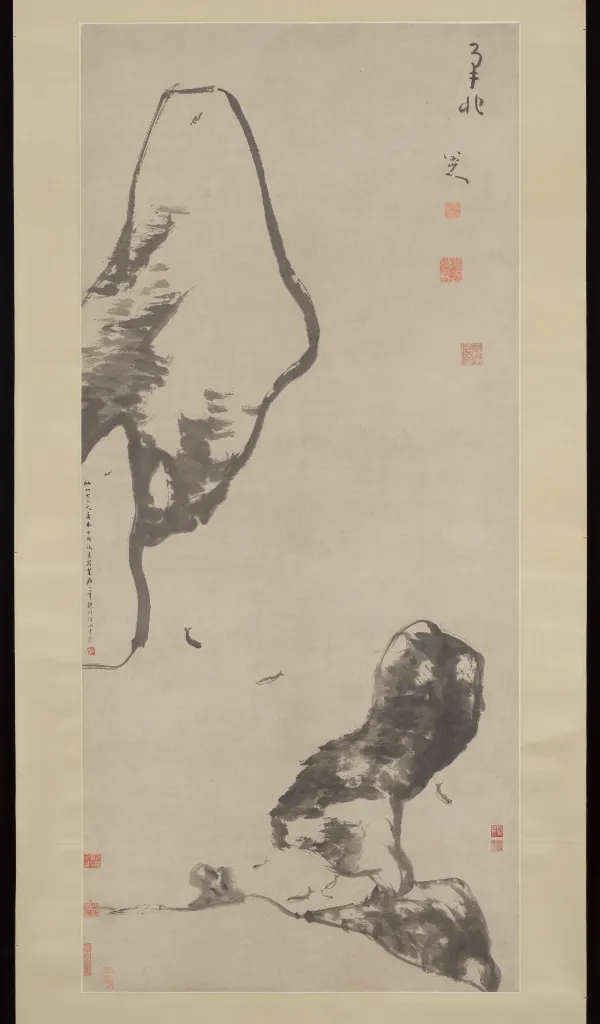
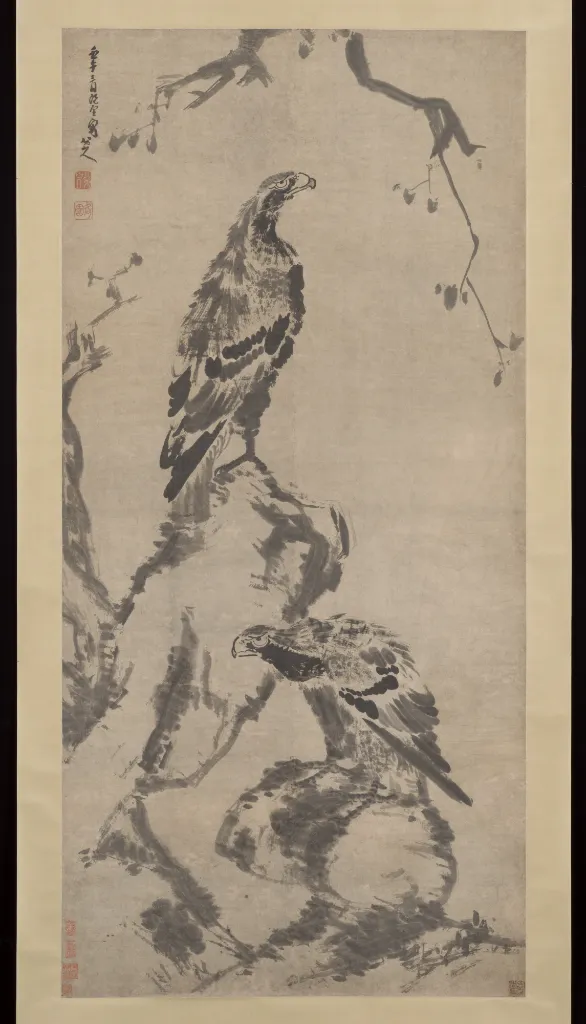
Bada Shanren (Zhu Da)’s Two Eagles (dated 1702) is a powerful ink-on-paper hanging scroll by one of the most distinctive painters of the early Qing dynasty—Bada Shanren, a leading Individualist master and a concealed descendant of the Ming imperial house. The work presents two eagles rendered with Bada’s signature austerity: piercing, unblinking eyes, sharply angled beaks, and bodies formed through abrupt, economical strokes. The surrounding blank space functions as a field of tension, turning the birds’ poised stillness into a scene often understood as psychological confrontation and silent intensity.
Artistic and Social Context Painted in Bada Shanren’s later years—after decades spent masking his identity as a surviving Ming prince—the work has been interpreted as reflecting both personal exile and the broader trauma of dynastic collapse. Created when Bada was around seventy‑six, in 1702, it is often read as a proud, barely veiled defiance toward Manchu Qing rule rather than as a neutral depiction of birds. Although eagles and hawks have no immediate precedent in his earlier oeuvre, the composition recalls the heroic bird imagery of early Ming court painter Lin Liang (ca. 1416–1480), whose powerful raptors symbolized strength and courage and were frequently associated with military officials. In this painting, Bada, a Ming loyalist, seems to reclaim and reinterpret that lineage, adapting Lin Liang’s more overtly militaristic symbolism and infusing it with personal grief, ideological resolve, and inner rebellion.
Interpretation and Meaning In Two Eagles, the birds function simultaneously as natural subjects and as allegorical figures that many viewers associate with loyalist resistance. Their rigid postures, taut silhouettes, and fiercely attentive gazes suggest confrontation, vigilance, and an unyielding spirit. Bada personalizes the traditional eagle motif, transforming it into an emblem that can be understood as brave resistance and steadfast loyalty—the noble birds standing sentinel over a land governed by foreign conquerors. Through spare brushwork and stark contrasts, he channels a lifetime of suppressed identity, restrained fury, and dignified solitude. The resulting image is not merely observational but can be read as a coded manifesto: an assertion of inner sovereignty and a testament to an unbroken will, even as alternative readings remain possible within modern scholarship.
Size and Location The painting’s image area measures 73 3/4 × 35 1/2 inches (approximately 187.3 × 90.2 cm), and with its full mounting it reaches about 122 3/4 × 42 1/2 inches (311.8 × 108 cm). The work is preserved in the Metropolitan Museum of Art, New York (accession number 2014.721).