The Last Supper
by Leonardo da Vinci
Description
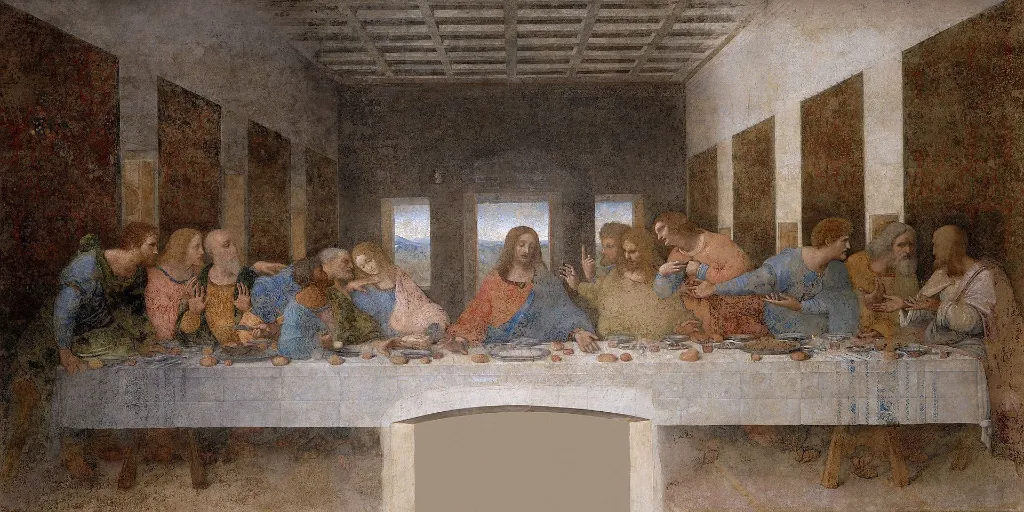
Leonardo da Vinci’s The Last Supper (Il Cenacolo, 1495–1498)—created by one of the universally acknowledged giants of the High Renaissance, a painter, inventor, anatomist, and polymath whose intellect shaped the very idea of the “Renaissance genius”—is a monumental mural depicting the moment Christ announces that one of the apostles will betray him. Painted for the refectory of Santa Maria delle Grazie in Milan, the composition stretches across the long dining hall wall, presenting Christ at the exact center, framed by a receding perspectival space that converges toward his calm, resigned face. Around him, the apostles react in explosive clusters of gesture and emotion: disbelief, outrage, fear, and sorrow ripple outward in a choreographed wave. Leonardo’s subtle modeling of light, his psychological insight, and his pioneering use of experimentational tempera-on-plaster technique create a scene of unprecedented dramatic unity and spiritual tension.
Artistic and Social Context Commissioned by Ludovico Sforza, Duke of Milan, the mural belongs to the high point of Leonardo’s Milanese period, when he rose to prominence not only as a painter but as an engineer, court intellectual, and artistic innovator. The work became a key model for later European narrative painting through its use of one-point perspective, cohesive narrative timing, and deeply individualized character study. Despite the fragility of Leonardo’s experimental medium—leading to early deterioration—the mural quickly became one of the most studied and copied images in Western art. Its influence spread through engravings and Renaissance workshops, shaping the development of Italian narrative painting and setting new standards for compositional harmony and emotional realism. Over centuries, successive restorations and scholarly debates have kept the work central to art historical inquiry.
Interpretation and Meaning Leonardo transforms a familiar biblical episode into a psychological drama of human vulnerability and divine serenity. Christ’s calm posture and downward gaze stand in deliberate contrast to the apostles’ agitation, embodying the theological tension between foreknowledge and human uncertainty. The grouping of apostles into triads reflects philosophical order amid crisis, while the empty plate, the spilled salt, and the rhythmic alignment of hands contribute layers of symbolic meaning relating to betrayal, sacrifice, and destiny. The room’s perspectival recession draws the viewer toward Christ as the vanishing point—both literally and spiritually—making the scene not just an illustration but a meditation on moral choice and divine purpose.
Size The mural measures approximately 460 × 880 cm (181 × 346 inches). It remains in situ in the refectory of Santa Maria delle Grazie, Milan, a UNESCO World Heritage site.