The Woman at the Well
by Diego Rivera
Description
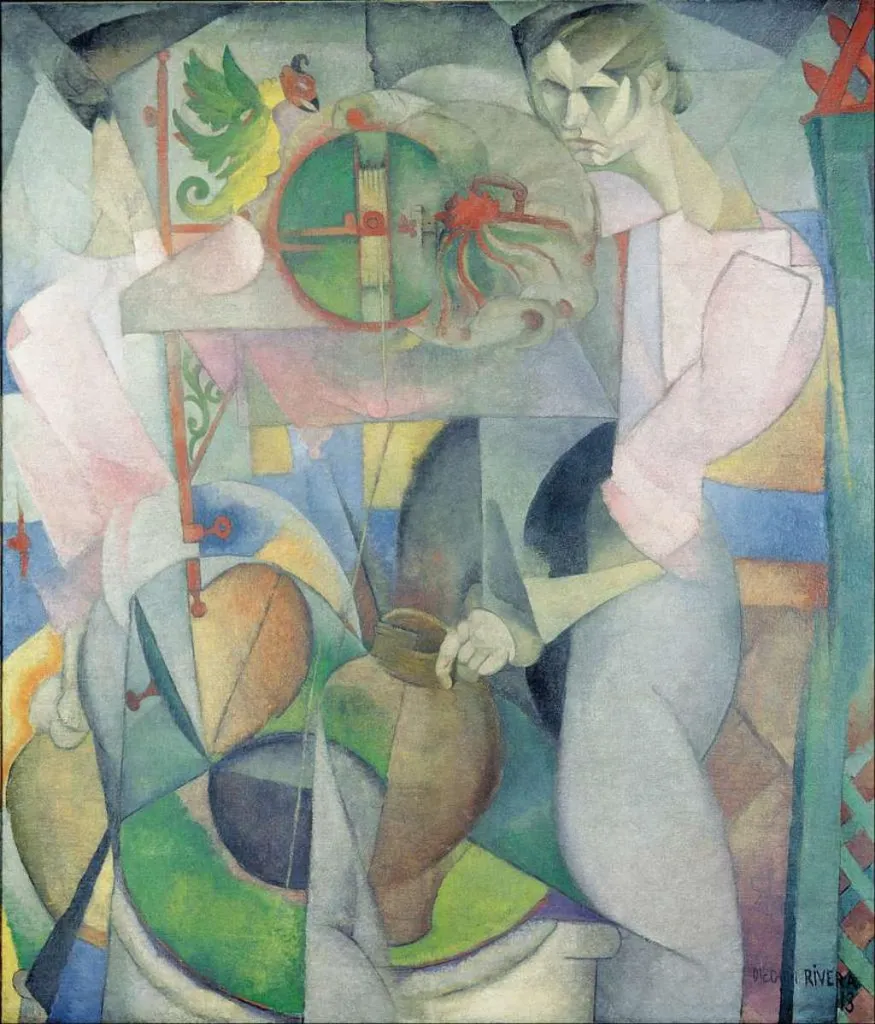
Diego Rivera’s The Woman at the Well (La mujer del pozo, 1913)—created by one of Mexico’s most influential modern artists—is an early oil painting that depicts a peasant woman drawing water from a well. Rivera renders the scene with a modernist sensibility, using geometric forms and fragmented planes influenced by Cubism. The woman’s sturdy, angular figure dominates the composition, her actions both ordinary and monumental, while the background is abstracted into rhythmic shapes and muted tones, emphasizing structure and form over literal realism.
Artistic and Social Context Painted during Rivera’s early period shortly after his European travels, the work reflects his engagement with contemporary avant-garde movements, particularly Cubism, and his experimentation with integrating modernist techniques into Mexican subject matter. Rivera was exploring how European artistic innovations could intersect with local culture, depicting everyday labor while also investigating compositional abstraction and formal experimentation. This period marks a bridge between his European-influenced early work and his later Mexican Muralism, where he would synthesize social realism and nationalist themes.
Interpretation and Meaning In this painting, Rivera transforms a simple act of labor into a study of human strength and vitality. The woman uses firm, powerful gestures to draw water, and through geometric segmentation and abstracted planes, her ordinary labor is elevated to convey a primal, substantial human force. The angularity of her body, the solidity of her stance, and the rhythmic abstraction of the surrounding forms impart a sense of resilience, endurance, and dignity. This formal experimentation not only highlights the physicality of work but also suggests deeper social and cultural resonance, portraying the peasant figure as a symbol of foundational human effort and the latent power inherent in everyday life.
Size The painting measures approximately 145 × 125 cm (57 × 49 inches) and is held in the Museo Nacional de Arte (MUNAL), Mexico City.