Totonac Civilization
by Diego Rivera
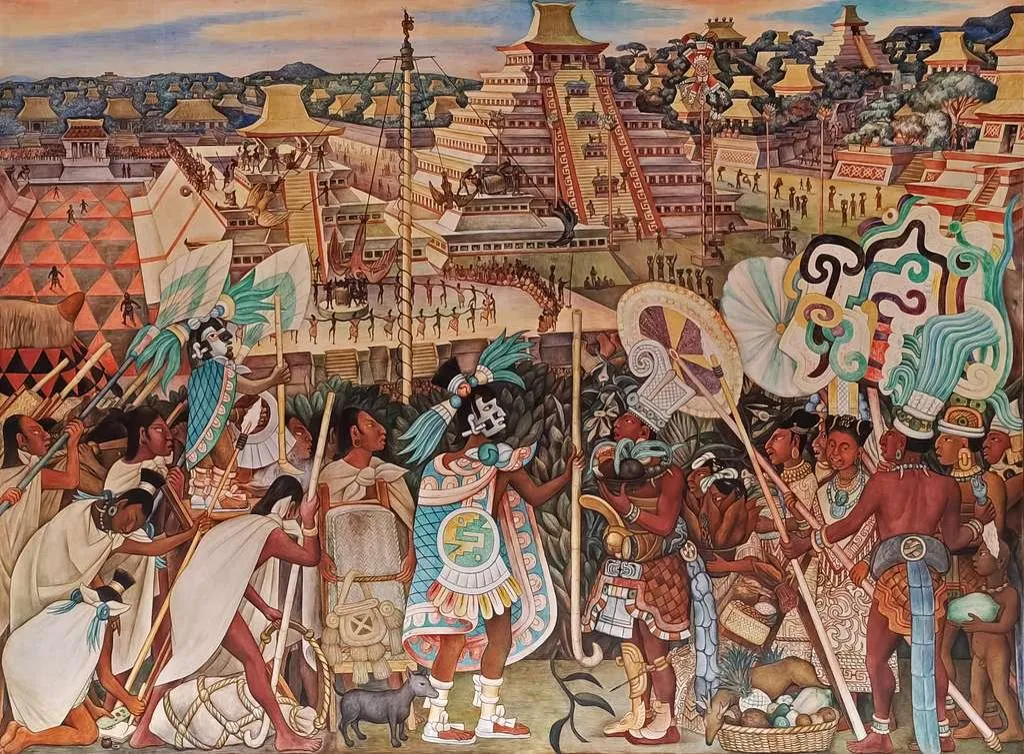
Description
Diego Rivera’s Totonac Civilization (1950) is a monumental fresco that forms part of his vast history mural cycle in the National Palace (Palacio Nacional) in Mexico City, celebrating pre-Hispanic civilizations and indigenous cultures as foundational to the Mexican nation. The composition focuses on Totonac society through scenes of ritual, agriculture, and communal labor: figures harvest and process maize, participate in ceremonial activities, and interact with emblematic deities and symbols of fertility, all rendered in Rivera’s bold, sculptural forms and tightly structured, rhythmic arrangements. His characteristic use of vibrant yet earthy colors and monumental, blocklike figures emphasizes the dignity and collective energy of Totonac life, turning historical narrative into a visually compelling epic.
Artistic and Social Context Painted in the mid-20th century, Totonac Civilization belongs to Rivera’s mature phase of public mural production, when he was consolidating decades of experimentation in fresco technique, Renaissance-inspired composition, and lessons drawn from Cubism into large-scale historical narratives. Rather than illustrating European themes, Rivera applies these tools to glorify Mexico’s indigenous heritage and to inscribe pre-Hispanic civilizations into a continuous, proudly national story. The work stands as a key example of the Mexican Muralism movement, which sought to educate and inspire a broad public by depicting the country’s history, labor, and social ideals on accessible civic walls. Within the National Palace cycle, Totonac Civilization contributes to Rivera’s broader project of visualizing Mexico’s past from an indigenous-centered perspective, reinforcing his status as a leading figure of the movement alongside José Clemente Orozco and David Alfaro Siqueiros.
Interpretation and Meaning In Totonac Civilization, Rivera presents the Totonac people as emblematic of Mexico’s rich pre-Hispanic heritage and as active shapers of their environment and spiritual world. The fresco emphasizes communal effort, ritual devotion, and intimate connection to the land, offering a vision of society unified by labor, belief, and shared tradition. By monumentalizing agricultural work and ceremonial practice on a governmental wall, Rivera elevates indigenous culture to heroic, almost mythic status, framing it as a living foundation rather than a vanished past. The work thus conveys both reverence for ancestral civilizations and a forward-looking social vision, suggesting that genuine national progress depends on recognizing and honoring indigenous roots.
Size The fresco measures approximately 16.1 × 17.2 feet (about 4.9 × 5.2 meters), covering an entire wall within the National Palace mural cycle. The fresco remains in situ in Mexico City and is accessible to the public as part of the National Palace’s historic mural program.