Cats Suggested as the Fifty-three Stations of the Tōkaidō
by Utagawa Kuniyoshi
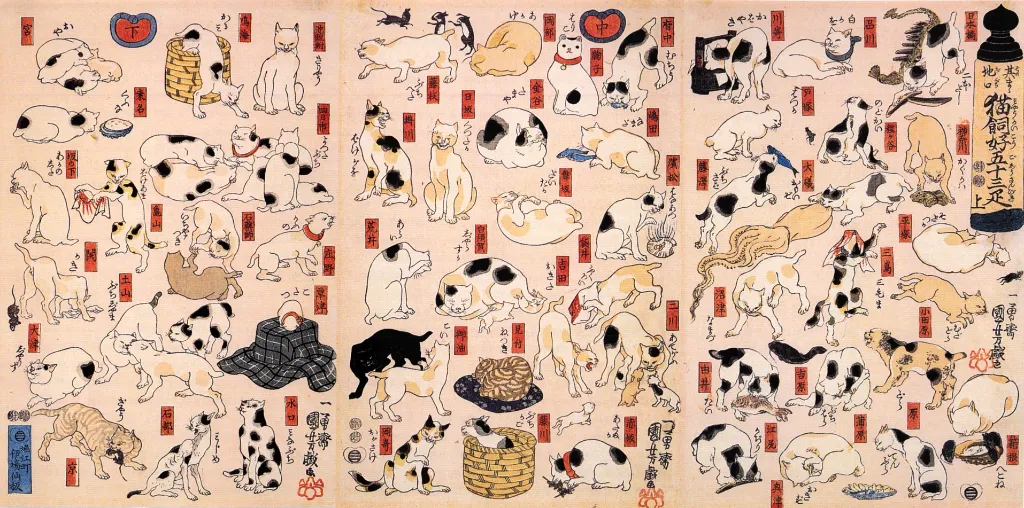
Description
Utagawa Kuniyoshi’s Cats Suggested as the Fifty-three Stations of the Tōkaidō** (c. 1840s)—created by one of the ukiyo-e “Three Great Masters”—is a playful and inventive vertical ōban triptych, that is, a composition printed on three adjoining sheets of the standard ōban size, in which Kuniyoshi reimagines the famous Fifty-three Stations of the Tōkaidō through anthropomorphized cats. Across the composition, individual cats and groups of cats serve as visual puns on the names of the stations, humorously echoing the poses, gestures, and activities of travelers, porters, samurai, and townspeople familiar from earlier Tōkaidō landscapes. Kuniyoshi combines dynamic composition, expressive feline gestures, and meticulously patterned garments to create a whimsical yet visually sophisticated interpretation, turning familiar geography and social activity into a delightful tableau of animalized Edo-period life.
Artistic and Social Context Produced during Kuniyoshi’s mature period, the triptych reflects the Edo audience’s appetite for humor, parody, and clever visual wordplay. A devoted cat-lover who kept several cats in his studio and frequently sketched them from life, Kuniyoshi drew on his intimate, affectionate observation of feline behavior to infuse these images with remarkable nuance and personality. While ukiyo-e often depicted kabuki actors, warriors, and landscapes, Kuniyoshi’s feline reinterpretation demonstrates his inventive blending of literary, theatrical, and popular motifs, and his creative response to increasing censorship of more overtly identifiable subjects. The design also exemplifies the Edo fascination with cats as symbols of playfulness and domesticity, capitalizing on urban audiences’ love for both humor and aesthetic elegance. It was widely admired for its ingenuity and has been celebrated by later illustrators and cartoonists as an early example of character-driven visual wit.
Interpretation and Meaning By replacing humans with cats, Kuniyoshi both entertains and offers subtle commentary on social roles and travel culture in Edo Japan. The animals’ expressive gestures and interactions mirror human behaviors, highlighting the universality of everyday struggles, humor, and communal activity. The triptych transforms the well-known journey along the Tōkaidō into a fantastical, lighthearted reflection on movement, human nature, and the playful imagination of the artist, blending parody with keen observation.
Size Each sheet of the triptych is in ōban format, the most common single-sheet size for Edo-period prints, measuring approximately 36 × 24 cm (about 14 1⁄4 × 9 1⁄2 inches). Notable impressions are preserved in major museum and private collections in Japan and abroad.