Takiyasha the Witch and the Skeleton Spectre (相馬の古内裏)
by Utagawa Kuniyoshi
Description
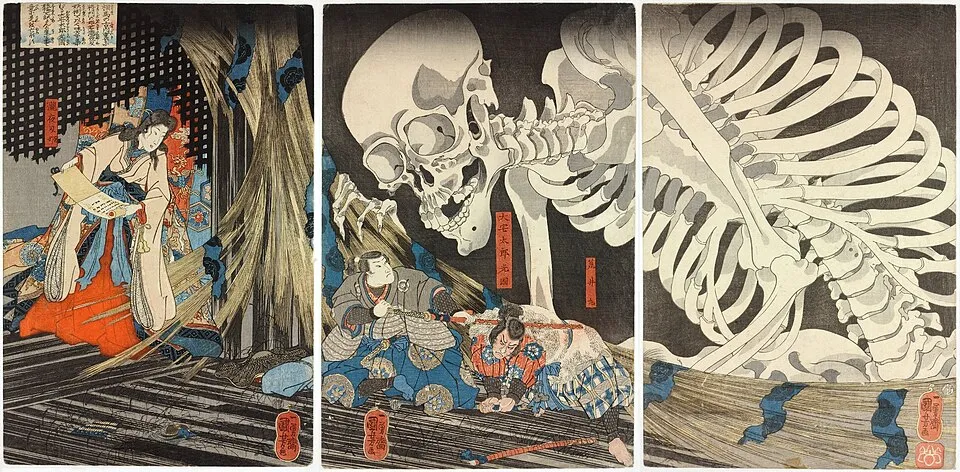
Utagawa Kuniyoshi’s Takiyasha the Witch and the Skeleton Spectre (相馬の古内裏, c. 1844–1845)—created by one of the ukiyo-e “Three Great Masters”—is a dramatic woodblock print depicting the legendary sorceress Takiyasha, daughter of the rebel Taira no Masakado, summoning a gigantic skeletal specter to terrify intruders. The enormous skeleton, rendered in stark white against a dark background, dominates the composition as it looms over a group of startled samurai, its bony fingers outstretched and spine curving with dynamic force. Takiyasha herself, smaller but intensely expressive, gestures commandingly from a doorway, her flowing robes and hair echoing the skeleton’s sinuous motion. Kuniyoshi’s use of bold lines, contrasting colors, and theatrical scale creates a spine-chilling, almost cinematic tableau.
Artistic and Social Context Produced in mid-19th-century Edo, the print is part of Kuniyoshi’s celebrated group of ghostly and supernatural subjects, reflecting the popular kaidan (ghost story) culture among urban audiences. Ukiyo-e artists like Kuniyoshi capitalized on the fascination with yōkai (monsters) and historical legends, blending literary narrative, kabuki theater, and imaginative exaggeration. The print showcases Kuniyoshi’s mastery of dramatic perspective, chiaroscuro, and theatricality, distinguishing him from contemporaries focused on landscapes or beauties. Its enduring appeal in the West, particularly among collectors and artists in the late 19th and early 20th centuries, helped solidify Kuniyoshi’s reputation as a master of heroic and fantastical imagery.
Interpretation and Meaning The scene embodies themes of supernatural power, rebellion, and moral tension. Takiyasha’s conjuring of the skeleton underscores her agency and magical prowess, while the spectral figure evokes both fear and awe, dramatizing the consequences of defiance and the fragility of human authority. Kuniyoshi transforms a narrative episode into a visual spectacle of movement and scale, where horror, theatricality, and artistry converge. The print celebrates imagination and the thrill of suspense, revealing Edo-period fascination with the uncanny and the heroic.
Size The original design is a vertical ōban woodblock triptych, each sheet measuring approximately 36 × 24 cm (about 14 1⁄4 × 9 1⁄2 inches), with a total width of around 72–74 cm. Fine impressions are held in major collections including the Victoria and Albert Museum, the British Museum, the Honolulu Museum of Art, and the RISD Museum.