Evening Snow at Kanbara (蒲原 夜雪)
by Utagawa Hiroshige
Description
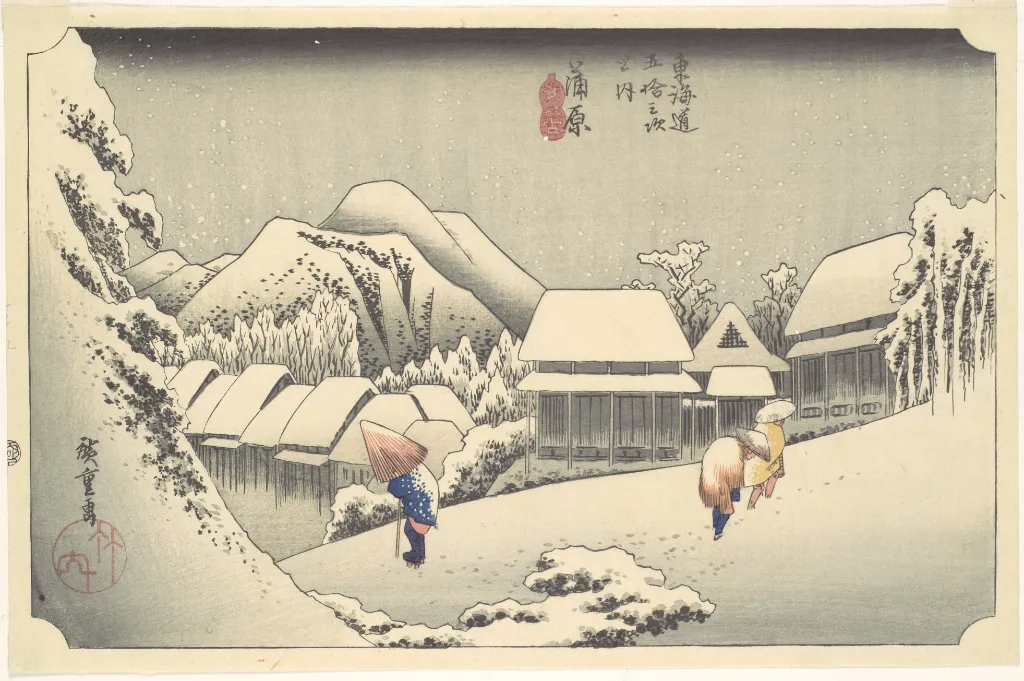
Utagawa Hiroshige’s Evening Snow at Kanbara (蒲原 夜雪, 1833–1834)—created by one of the ukiyo-e “Three Great Masters”—is a serene and haunting print from the series Fifty-three Stations of the Tōkaidō. It depicts the remote post station of Kanbara under a heavy evening snowfall. Thatched-roof houses are partially buried in snow, their warm interior lights glowing faintly through the windows, while travelers and villagers move cautiously along narrow paths. The muted palette of soft whites, greys, and pale blues emphasizes stillness, and the low horizon with distant snow-covered hills imparts a sense of isolation and quiet contemplation. The composition balances human habitation with the enveloping power of winter, turning a simple provincial town into a scene of poetic introspection.
Artistic and Social Context Produced during Hiroshige’s early maturity, the print demonstrates his mastery of weather effects and atmospheric perspective. Published by Hoeidō (Takenouchi Magohachi) as part of the Fifty-three Stations series, it was intended for a broad audience of travelers, merchants, and art enthusiasts in Edo-period Japan. Its elegant depiction of seasonal and climatic variations contributed to the series’ popularity and commercial success. European collectors in the late 19th century revered prints like Evening Snow at Kanbara for their subtle tonal harmonies, compositional sophistication, and ability to evoke mood through minimalistic design. The work influenced Impressionist and Post-Impressionist artists seeking to capture fleeting natural phenomena with economy and lyricism.
Interpretation and Meaning The print evokes the quiet endurance of daily life amidst the forces of nature. Snow blankets both village and travelers alike, suggesting the impartial, leveling hand of winter. Hiroshige emphasizes human resilience through small, deliberate gestures: a figure trudging through snow, a faint plume of smoke rising from a chimney. At the same time, the subdued light and soft contours convey calm, encouraging reflection on the impermanence and serenity inherent in natural cycles. The scene transforms ordinary travel into a meditation on stillness, seasonality, and harmony between humans and their environment.
Size The original oban woodblock print measures approximately 24.1 × 36.8 cm (9 1⁄2 × 14 1⁄2 inches). Early impressions are preserved in the Metropolitan Museum of Art, the British Museum, and the Honolulu Museum of Art.