South Wind, Clear Sky (凱風快晴)
by Katsushika Hokusai
Description
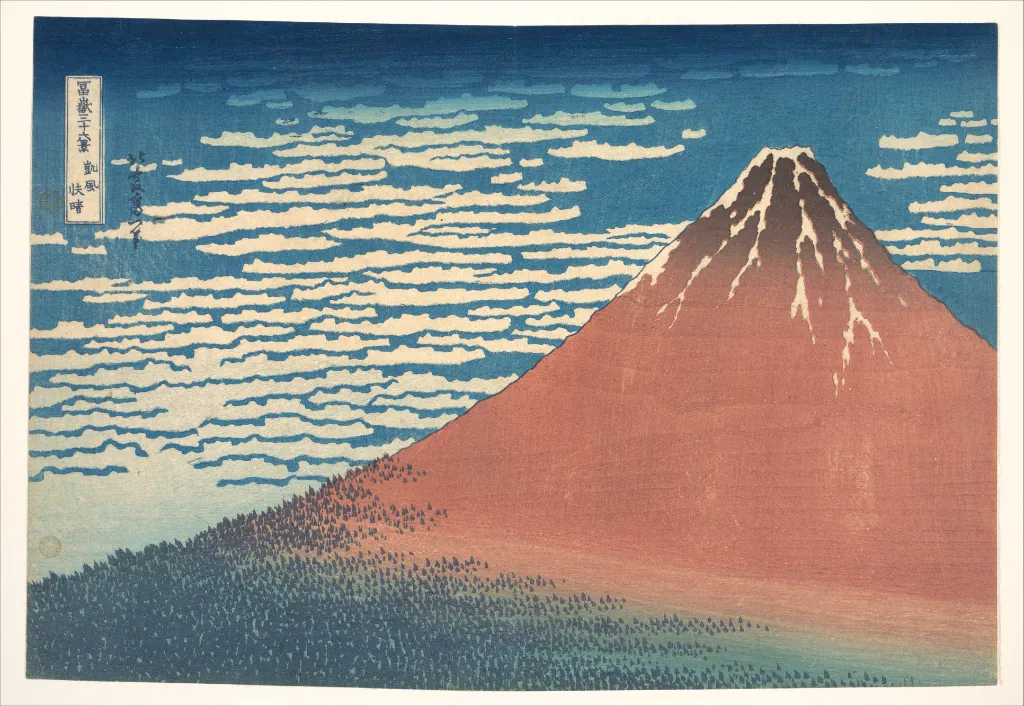
Katsushika Hokusai’s South Wind, Clear Sky (凱風快晴, c. 1830–1832)—created by one of the ukiyo-e “Three Great Masters”—is a luminous woodblock print from Thirty-six Views of Mount Fuji, presenting the sacred mountain bathed in the pure clarity of early autumn. Often called “Red Fuji,” the print captures the exact moment when the rising sun strikes Fuji’s slopes, turning them a burnished, russet red that stands in bold contrast to the crisp blue sky mottled with delicate white clouds. The sharply angled planes of the mountain, rendered with minimal but decisive gradations, create a sense of monumental stillness and geometric perfection. Unlike Hokusai’s dramatic wave scene, this image achieves its power through serenity, balance, and radiant color.
Artistic and Social Context Produced during Hokusai’s late Edo-period maturity, the print demonstrates his masterful use of the newly popular Prussian blue pigment and related blue-toned printing techniques, combined here with warm cinnabar tones. Issued by the publisher Nishimuraya Yohachi, the work reached a broad audience in Japan and quickly became one of the most admired prints of the series. When Japanese art flooded European markets in the late 19th century, “Red Fuji” fascinated collectors and artists—its radical simplicity and almost modern abstraction resonated with Impressionists and later with Minimalists. Today it stands, alongside The Great Wave, as a defining image of Fuji’s spiritual and aesthetic presence.
Interpretation and Meaning South Wind, Clear Sky transforms Fuji into a symbol of cosmic harmony. The mountain’s glowing red flank suggests vitality, renewal, and the auspiciousness of early autumn, a season traditionally associated with clarity and good fortune. Its unshaken form against a pristine sky reflects a worldview rooted in Shinto and Buddhist ideas of permanence amid change. By reducing the composition to sky, cloud, and mountain, Hokusai elevates Fuji from a landscape feature to a universal emblem of stability and inner calm—a moment of enlightenment rendered as color and line.
Size The original print measures approximately 25.7 × 37.9 cm (10 1⁄8 × 14 15⁄16 inches). Fine impressions are held in major collections including the Metropolitan Museum of Art, the British Museum, and the Freer Gallery of Art.