The Great Wave off Kanagawa (神奈川沖浪裏)
by Katsushika Hokusai
Description
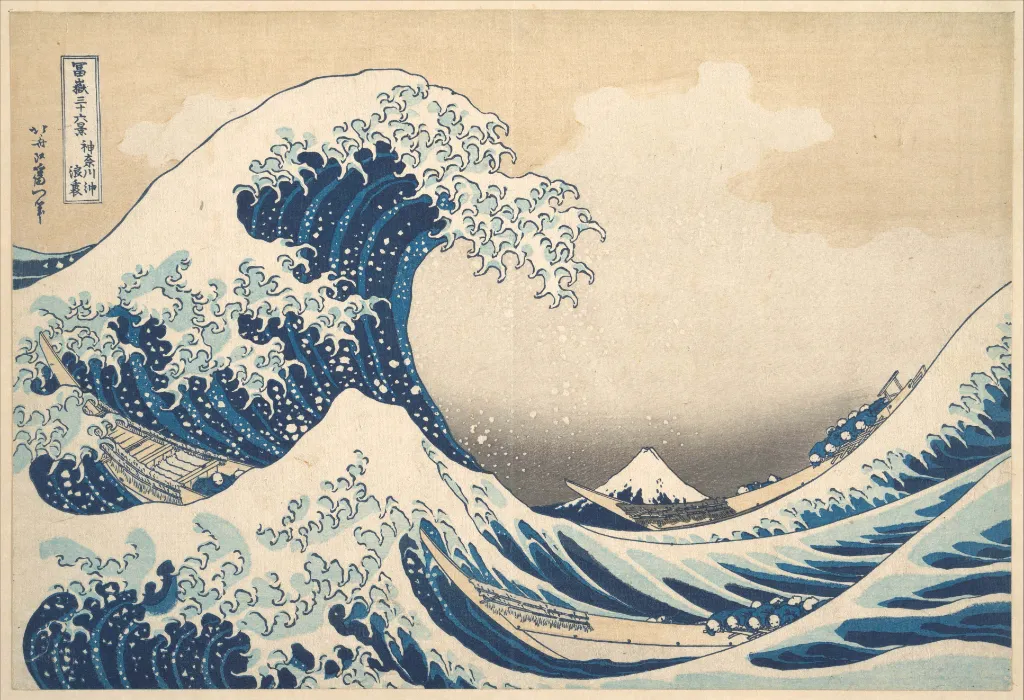
Katsushika Hokusai’s The Great Wave off Kanagawa (神奈川沖浪裏, c. 1830–1832)—created by one of the ukiyo-e “Three Great Masters” alongside Hiroshige and Kuniyoshi—is the iconic woodblock print from the series Thirty-six Views of Mount Fuji, presenting a monumental cresting wave frozen at the instant it is about to crash over three fragile oshiokuri-bune boats. The claw-like curve of the wave forms a vast, foaming canopy that visually dwarfs the distant, immovable Mount Fuji—reduced to a calm triangular peak on the horizon. The contrasting rhythms of violent motion and serene stillness, rendered in Prussian blue with exquisite linework, create a composition of perfect tension: nature’s overwhelming force against human perseverance.
Artistic and Social Context Produced during the late Edo period, the print reflects Hokusai’s mature synthesis of Japanese ukiyo-e traditions and newly imported Western visual ideas—linear perspective, shading, and especially the newly available synthetic Prussian blue pigment. Issued by the publisher Nishimuraya Yohachi, the print circulated widely and inexpensively, reaching merchants, travelers, and artisans across Japan. In the late 19th century, when Japanese prints entered Europe, The Great Wave became a central image of Japonisme, influencing Monet, Degas, Whistler, and later Van Gogh. Its bold graphic clarity and modern sense of dynamism made it one of the most reproduced artworks in world history, emblematic of ukiyo-e’s global impact.
Interpretation and Meaning Though often read as a scene of impending disaster, Hokusai’s composition also celebrates harmony between human resilience and the natural world. The fishermen bend with the wave rather than resist it, mirroring the Buddhist-inflected view of Fuji as a symbol of endurance and spiritual stability. The wave’s circular arc echoes the shape of Fuji itself, suggesting an eternal cycle of power, transience, and renewal. As an opening image of the Thirty-six Views, it presents the sacred mountain not through still contemplation but through the drama of daily life—Fuji as constant, life as movement.
Size The original print measures approximately 25.7 × 37.9 cm (10 1⁄8 × 14 15⁄16 inches). Major early impressions are held in the Metropolitan Museum of Art, the British Museum, and the Tokyo National Museum.