The Continence of Scipio (La Continenza di Scipione)
by Vincenzo Camuccini
Description
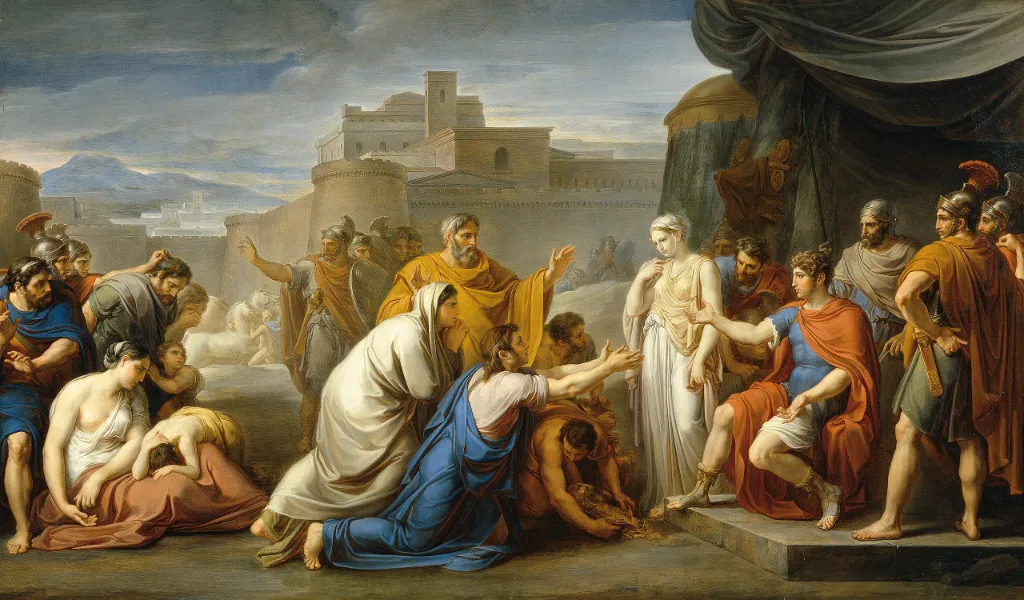
Vincenzo Camuccini’s The Continence of Scipio (La Continenza di Scipione, 1807–1809) is a grand Neoclassical oil on canvas that presents the young Roman general Scipio Africanus at the pinnacle of moral triumph during the capture of New Carthage in 209 BC. Seated on an elevated throne beneath a solemn Roman portico, Scipio extends a commanding yet benevolent gesture toward the kneeling Celtiberian bride and her fiancé Allucius, returning her untouched while simultaneously refusing the glittering ransom gold offered by her parents. Soldiers, captives, and onlookers form a perfectly symmetrical, theatrical ensemble—some in attitudes of awe, others presenting spoils—creating a majestic tableau of disciplined emotion and republican virtue.
Artistic and Social Context
Painted in Rome for Prince Nikolai Yusupov (Russian ambassador and one of the greatest collectors of the era), Camuccini’s canvas represents the triumphant climax of Italian Neoclassicism. Executed in the same years as his famous Death of Caesar, it rivals David’s severity while adding a warmer, more Italianate grace. Exhibited to acclaim in Rome and later in Paris under Napoleon (who admired Camuccini’s work), it was instantly engraved and distributed across Europe, becoming one of the most widely reproduced images of Roman magnanimity in the early 19th century. Its archaeological precision—togas, armor, and architecture meticulously copied from ancient sources—made it a cornerstone of academic history painting.
Interpretation and Meaning
Camuccini transforms Scipio’s act into a sublime celebration of enlightened leadership: continence—restraint of pleasure and rejection of personal gain—elevated to the level of imperial destiny. The rigidly symmetrical composition and crystalline lighting lend the scene an almost sacred aura, presenting Scipio as a proto-emperor who rules through moral superiority rather than force. Painted during the Napoleonic era, it subtly flatters absolute rulers who wished to be seen as magnanimous conquerors, while simultaneously upholding the old republican ideal of virtuous self-denial.
Size
The original painting measures 225 × 352 cm (88 ½ × 138 ½ inches) and is conserved in the Galleria Nazionale d’Arte Moderna e Contemporanea, Rome.