The Continence of Scipio
by Nicolas Poussin
Description
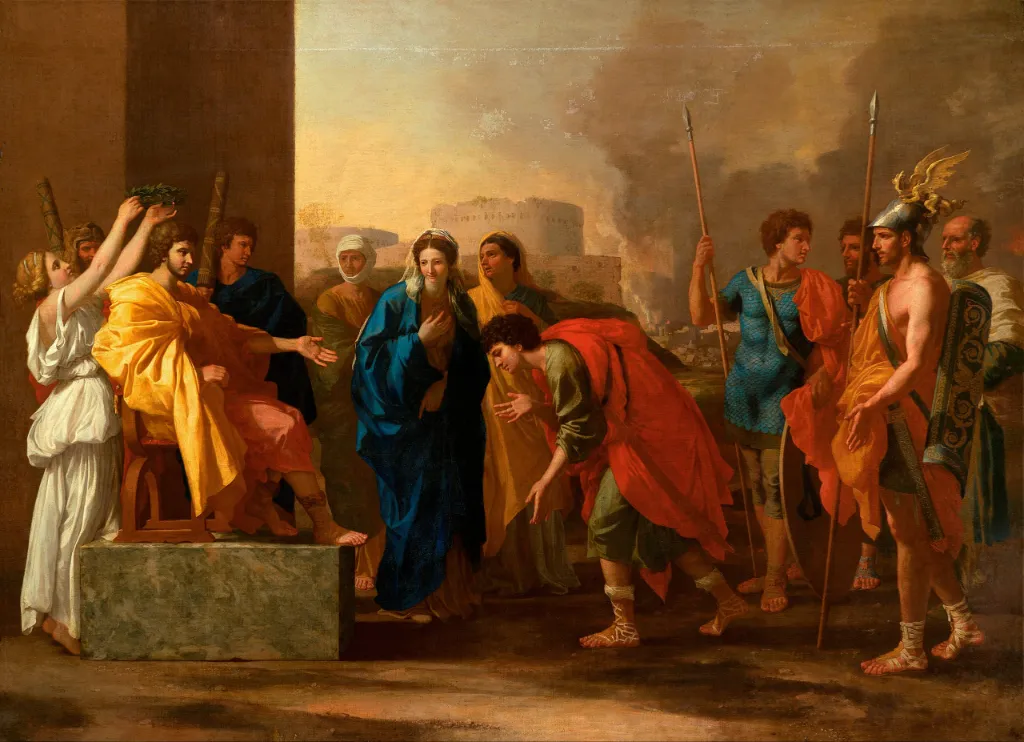
Nicolas Poussin’s The Continence of Scipio (1640) is a majestically composed oil on canvas that captures the moment of supreme moral restraint when the young Roman general Publius Cornelius Scipio Africanus, during the siege of New Carthage in 209 BC, returns a beautiful captive bride untouched to her fiancé Allucius and refuses the ransom gold offered by her parents. Enthroned on the left beneath a classical portico, Scipio gestures with calm authority toward the kneeling, tearful fiancée and the grateful Celtiberian prince, while soldiers present the girl and her parents offer heaps of gold that Scipio magnanimously rejects. The figures are arranged in a serene, frieze-like procession across the canvas, every gesture and expression perfectly measured to convey dignity, gratitude, and virtuous self-control.
Artistic and Social Context
Painted in Rome for the French collector Michel Passart and later acquired by the duc de Richelieu, Poussin’s canvas is the supreme masterpiece of 17th-century French classical history painting. Executed at the height of his “severe” Roman period, it embodies his ideal of the “grand manner”: rational composition, archaeological accuracy (togas, armor, and architecture drawn from ancient sources), and stoic moral clarity inspired by Stoic philosophy and Livy’s histories. Instantly celebrated and widely engraved, it became the canonical image of Roman virtue for the French Academy and European courts, serving as a model of enlightened leadership and restraint of pleasure during the age of Louis XIV.
Interpretation and Meaning
The painting elevates continence—restraint of pleasure and rejection of personal gain—into the highest expression of heroic virtue. Through its balanced, almost architectural composition and restrained emotional register, Poussin transforms a wartime episode into a timeless lesson in moral governance: true power lies in self-mastery rather than conquest. Scipio’s serene authority contrasts with the emotional turbulence of the captives, making the Roman general a near-divine exemplar of reason triumphing over passion and greed, an ideal that resonated deeply with 17th- and 18th-century theories of just rule.
Size
The original painting measures 116 × 174 cm (45 ⅝ × 68 ½ inches) and is conserved in the Pushkin State Museum of Fine Arts, Moscow.