The Murder of Caesar (Der Mord des Caesar)
by Karl Theodor von Piloty
Description
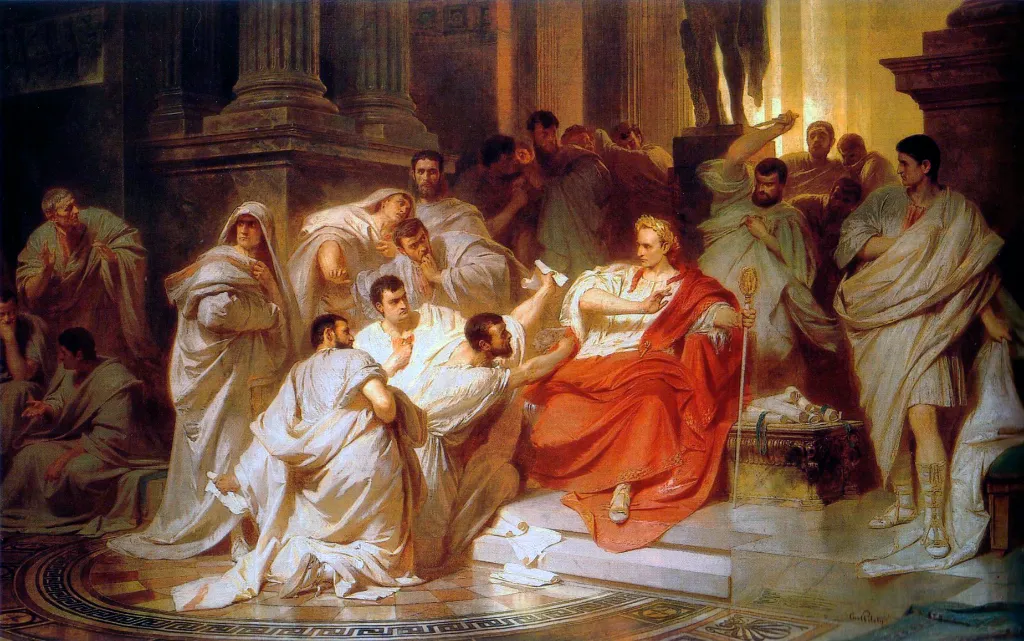
Karl Theodor von Piloty’s The Murder of Caesar (Der Mord des Caesar, also known as Thusnelda and the Murder of Caesar in some sources, 1865) is a vast, theatrical oil on canvas that captures the exact instant of Julius Caesar’s assassination in the portico of the Theatre of Pompey on the Ides of March, 44 BC. In the center, a defiant Caesar, his toga half-torn and blood streaming from multiple wounds, stands upright for one final moment, staring down his attackers with superhuman dignity. Around him swirl the sixty conspirators—Brutus and Cassius most prominent—lunging with daggers in a frenzy of motion, while terrified senators scatter in every direction amid overturned benches and fallen scrolls. The colossal statue of Pompey looms ironically in the background, bathed in cold Roman light.
Artistic and Social Context
Painted in Munich in 1865 for King Ludwig II of Bavaria, Piloty’s canvas is the crowning achievement of the late-German Romantic history painting school he founded. Rejecting the restrained idealism of Neoclassicism, Piloty embraced intense realism, dramatic lighting inspired by Rembrandt and Rubens, and meticulous archaeological detail (armor, togas, and architecture drawn from the latest Roman excavations). Exhibited to enormous acclaim at the 1865 Munich International Exhibition and later in Paris, it established Piloty as the “German Gerôme” and became one of the most reproduced 19th-century images of the assassination, influencing everything from academic salons to early cinema.
Interpretation and Meaning
The painting glorifies the tragic grandeur of the event rather than taking a clear moral side. Caesar’s almost Christ-like composure in the face of death elevates him to mythic status, while the conspirators—lit by shafts of dramatic light—appear both heroic and fanatical. The swirling chaos and operatic scale transform the assassination into a universal spectacle of fate, betrayal, and the fragility of power, perfectly matching mid-19th-century Europe’s fascination with doomed empires and larger-than-life leaders.
Size
The original painting measures 285 × 715 cm (112 × 281 inches), making it one of the largest and most overwhelming 19th-century history paintings ever created (Bavarian State Painting Collections, Neue Pinakothek, Munich).