The Death of Julius Caesar (Morte di Cesare)
by Vincenzo Camuccini
Description
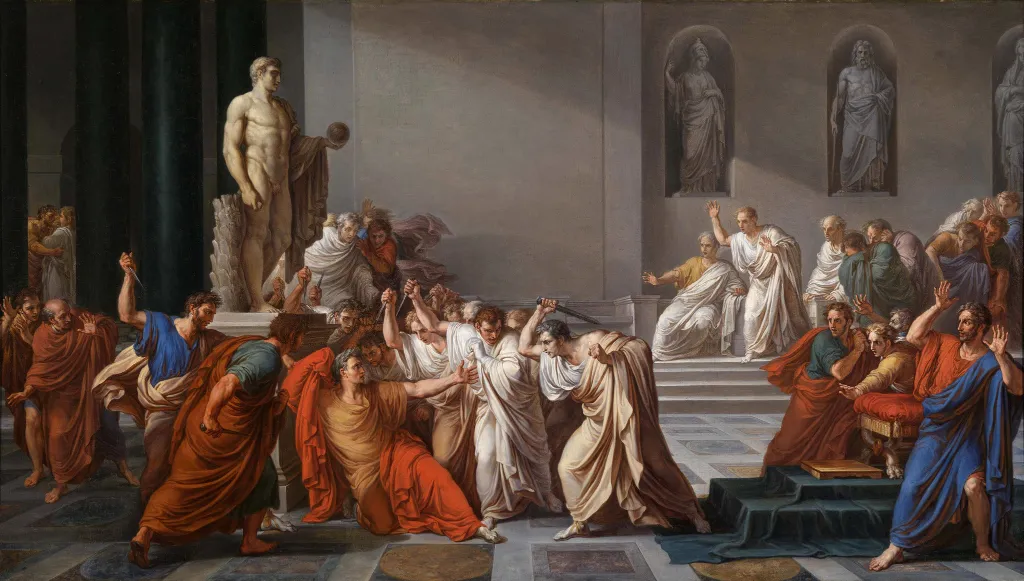
Vincenzo Camuccini’s The Death of Julius Caesar (Morte di Cesare, 1798, with the final version completed in 1806) is a monumental Neoclassical oil on canvas depicting the dramatic moment immediately following the assassination of Julius Caesar in the Theatre of Pompey on the Ides of March, 44 BC. At the foot of the towering statue of Pompey the Great, Caesar lies dead on the senate floor, his toga drenched in blood, while the conspirators—led by a resolute Brutus and Cassius—brandish their daggers and raise their arms in a mixture of triumph and agitation. Senators flee in panic or stand frozen in horror, creating a powerful contrast between heroic resolve and chaotic terror.
Artistic and Social Context
Completed during the height of European Neoclassicism and exhibited in Rome and later Paris (where Napoleon himself admired it), Camuccini’s painting became the definitive 19th-century visualization of Caesar’s murder. Influenced by Jacques-Louis David’s revolutionary classicism and ancient Roman relief sculpture, the work embodies the era’s fascination with republican virtue, the dangers of tyranny, and the dramatic fall of great leaders. Widely reproduced through engravings, it shaped popular and academic imagination of the event for generations and served as a political allegory during the Napoleonic age—simultaneously warning against dictatorship and glorifying decisive action.
Interpretation and Meaning
The painting freezes the pivotal instant when liberty is supposedly reborn through violence. The towering, ironic presence of Pompey’s statue underscores the tragic cycle of Roman history, while Brutus’s upward gaze and outstretched arm lend him a tragic, almost Christ-like nobility. Camuccini balances moral ambiguity: the conspirators appear both heroic and frenzied, turning the assassination into a timeless meditation on power, betrayal, and the cost of political idealism. Its theatrical composition and archaeological precision made it one of the most influential history paintings of its century.
Size
The principal version (Galleria Nazionale d’Arte Moderna e Contemporanea, Rome) measures 400 × 707 cm (157 × 278 inches), making it one of the largest and most imposing Neoclassical canvases ever painted.