The Wood and the Suicide (The Divine Comedy—Inferno, Canto 13)
by Salvador Dalí
Description
Circle 7 is dedicated to the violent and is subdivided into three rings: the outer ring for violence against others, the middle ring for violence against self (suicides) and against nature/God (including the violent against nature and the prodigal, punished together in the third ring of burning sands), and the inner ring for violence against God (blasphemers). In the second ring, suicides—who violently rejected the body God gave them—are transformed into gnarled, thorny trees, their branches torn by Harpies or shattered by the violent prodigals, causing them to bleed and speak only when wounded, symbolizing the self-destructive rejection of their human form.
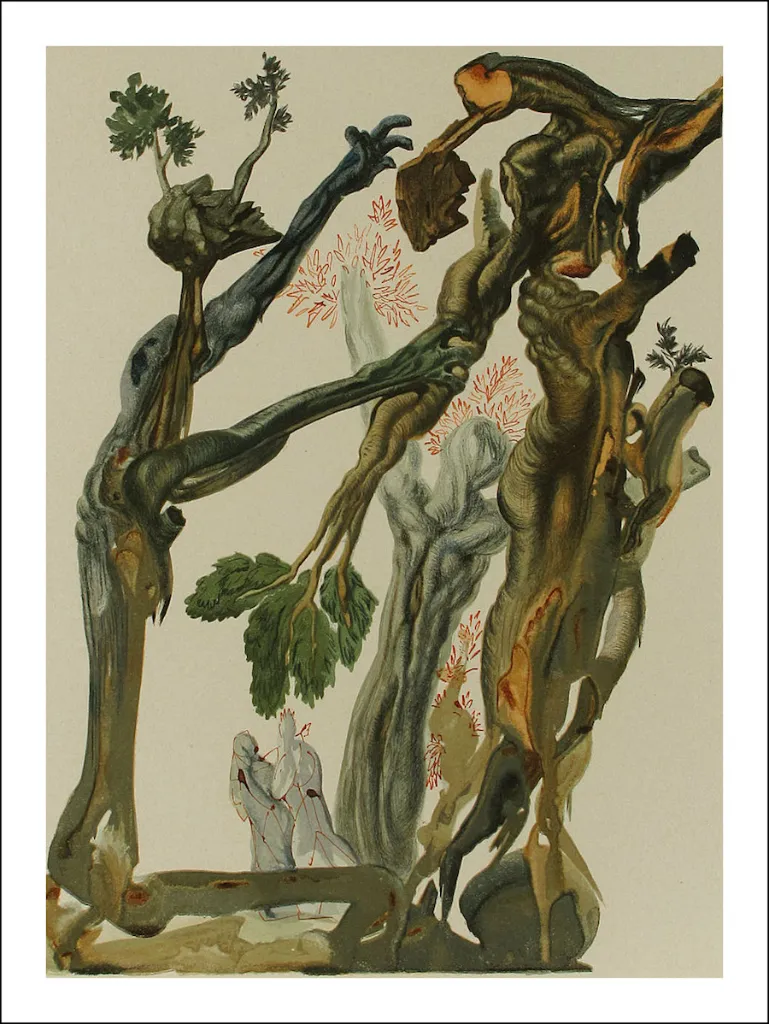
Dalí’s illustration for the second ring of violence depicts the wood of the suicides in their tormented forest—Hell’s seventh circle. Twisted, bleeding trees with human-like limbs and faces emerge from a barren, surreal landscape, their branches contorted in agony as blood drips from broken twigs, evoking a haunting fusion of human despair and vegetal permanence in Dalí’s dreamlike, distorted style. Shadowy figures and elongated forms blend into the thorny thicket, capturing the eerie stillness and profound sorrow of souls forever denied their bodily resurrection.
Artistic and Social Context
Created as part of Dalí’s mid‑century Divine Comedy cycle, The Wood and the Suicide channels Dante’s bleak forest of the self‑damned through the artist’s surreal, psychological lens. By turning the souls of suicides into twisted, bleeding trees amid a haunted thicket, Dalí fuses medieval theology with modern anxieties about despair, embodiment, and identity, transforming a doctrinal punishment scene into a contemporary meditation on irreversible loss and inner violence.
Interpretation and Meaning
Dalí’s depiction underscores the tragedy of suicide as ultimate self-betrayal—the souls’ transformation into trees reflects their violent discard of God’s gift of the body, now trapped in perpetual pain and immobility, bleeding only when harmed, emphasizing isolation, regret, and the loss of humanity.
Size
The print is about 25.5 × 18 cm (10 × 7 in), consistent with other works in Dalí’s Divine Comedy suite.