Farinata (The Divine Comedy—Inferno, Canto 10)
by Salvador Dalí
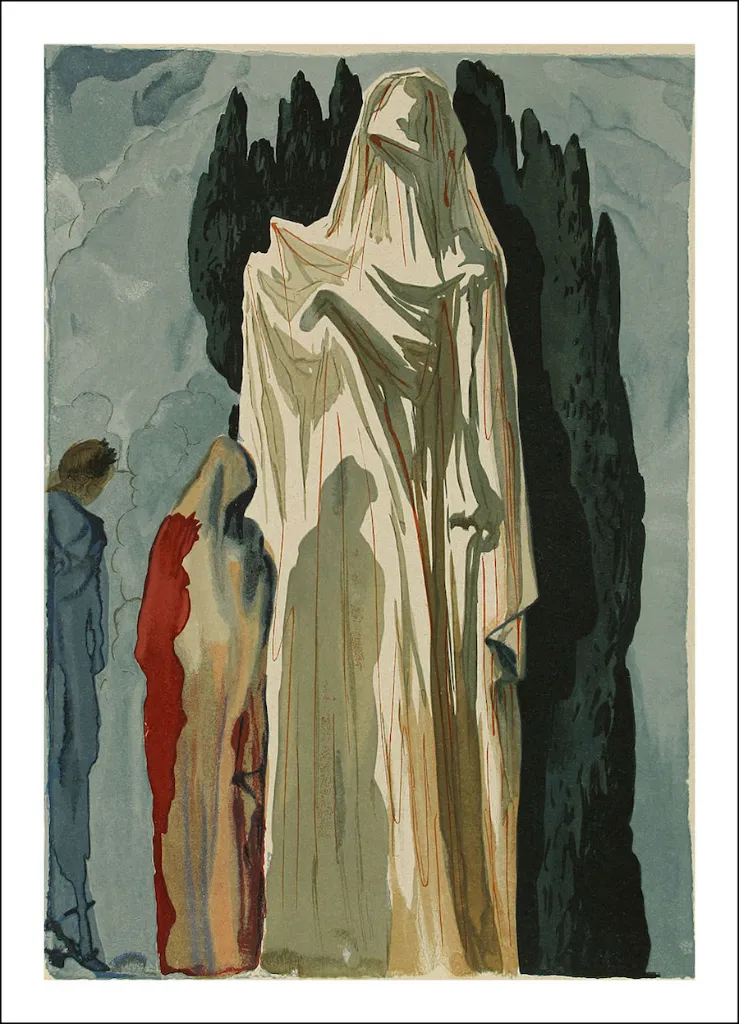
Description
Circle 6 is reserved for heretics—those who denied the immortality of the soul or key Christian doctrines (often Epicureans in Dante’s view)—who lie or rise from open, flaming tombs within the walled city of Dis, their fiery sepulchers symbolizing the burning error of their false beliefs, with the lids destined to close forever after Judgment Day.
Dalí’s illustration captures the proud Ghibelline leader Farinata degli Uberti rising defiantly from his fiery tomb in the cemetery of the heretics—Hell’s sixth circle. Surreal, elongated figures emerge amid a landscape of open sarcophagi engulfed in vibrant, leaping flames, contrasted with shadowy, despairing forms and melting distortions in Dalí’s dreamlike style, evoking both the scorching punishment and the unyielding arrogance of the damned souls.
Artistic and Social Context
Farinata translates Dante’s proud Florentine heretic into a modern, surreal icon of defiance. Rising from his flaming tomb in a fractured, dreamlike architecture, Farinata embodies both medieval heresy and twentieth‑century questions about ideology, exile, and spiritual ruin, as Dalí uses his distinctive style to turn a doctrinal punishment scene into a psychologically charged meditation on pride under judgment.
Interpretation and Meaning
Dalí’s depiction highlights the irony of heresy—the sinners’ denial of the soul’s eternity now met with eternal fiery confinement—while Farinata’s proud posture underscores themes of political division, intellectual hubris, and the haunting persistence of earthly rivalries even in damnation.
Size
The print is about 25.5 × 18 cm (10 × 7 in), consistent with other works in Dalí’s Divine Comedy suite.