The Avaricious and the Prodigal (The Divine Comedy—Inferno, Canto 7)
by Salvador Dalí
Description
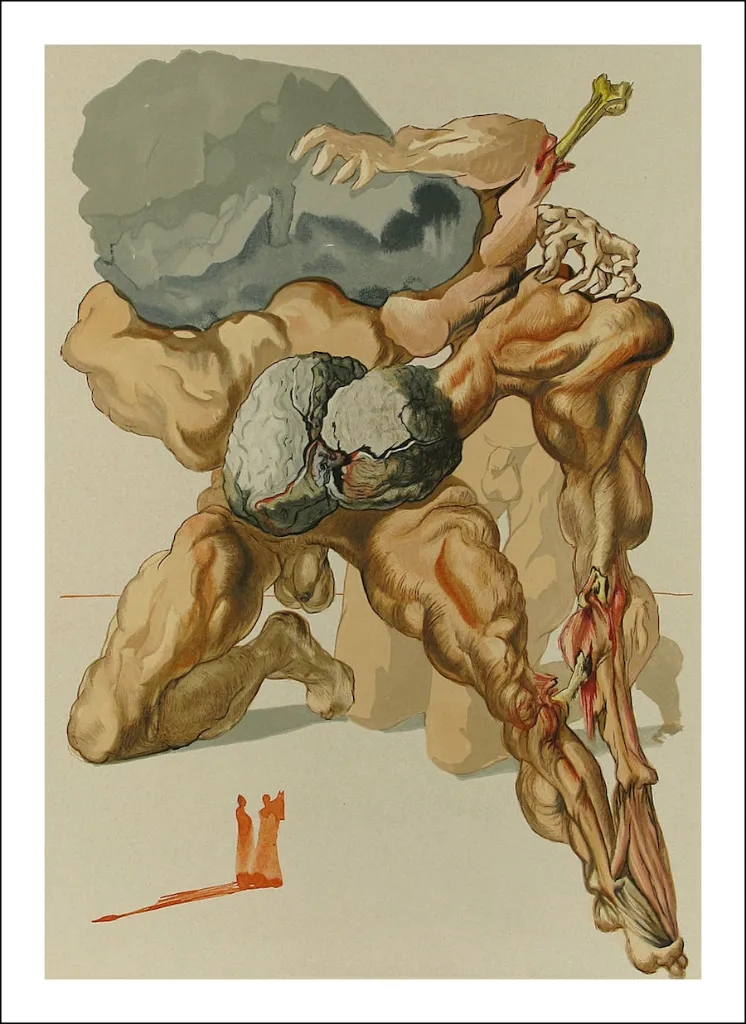
Circle 4 is dedicated to the avaricious (hoarders/greedy) and the prodigal (wasters/squanderers)—two opposite extremes of the same vice of disordered attachment to material goods. The hoarders and wasters are condemned to roll enormous weights toward one another in semicircles, crashing violently together at the midpoint before wheeling around to repeat the process eternally, their ceaseless, futile labor symbolizing how in life they misused fortune’s gifts through either obsessive clinging or reckless dissipation.
Dalí’s illustration shows the hoarders and prodigals locked in their brutal, repetitive clash—Hell’s fourth circle. Massive, distorted boulders are pushed by warped, melting human figures whose elongated limbs and contorted bodies strain in endless opposition, set against a barren plain under a stormy sky in Dalí’s signature surreal style, evoking the absurd futility and mutual destruction of greed in its dual forms.
Artistic and Social Context
The Avaricious and the Prodigal grew out of the same mid‑century project first commissioned (and then rejected) by Italian authorities who objected to a Spanish surrealist honoring Dante. Dalí carried on with French publishers, translating Dante’s clash of hoarders and wasters into his own language of elongated bodies and barren, stage‑like space, turning medieval moral satire into a modern image of compulsive accumulation and waste that speaks to postwar anxieties about money, excess, and spiritual emptiness.
Interpretation and Meaning
Dalí’s depiction emphasizes the perfect contrapasso of the punishment—the two groups who could never find balance in life now smash against each other forever, their weights representing the crushing burden of material obsession and the meaningless cycle of accumulation and waste.
Size
The print is about 25.5 × 18 cm (10 × 7 in), consistent with other works in Dalí’s Divine Comedy suite.