Minos (The Divine Comedy—Inferno, Canto 5)
by Salvador Dalí
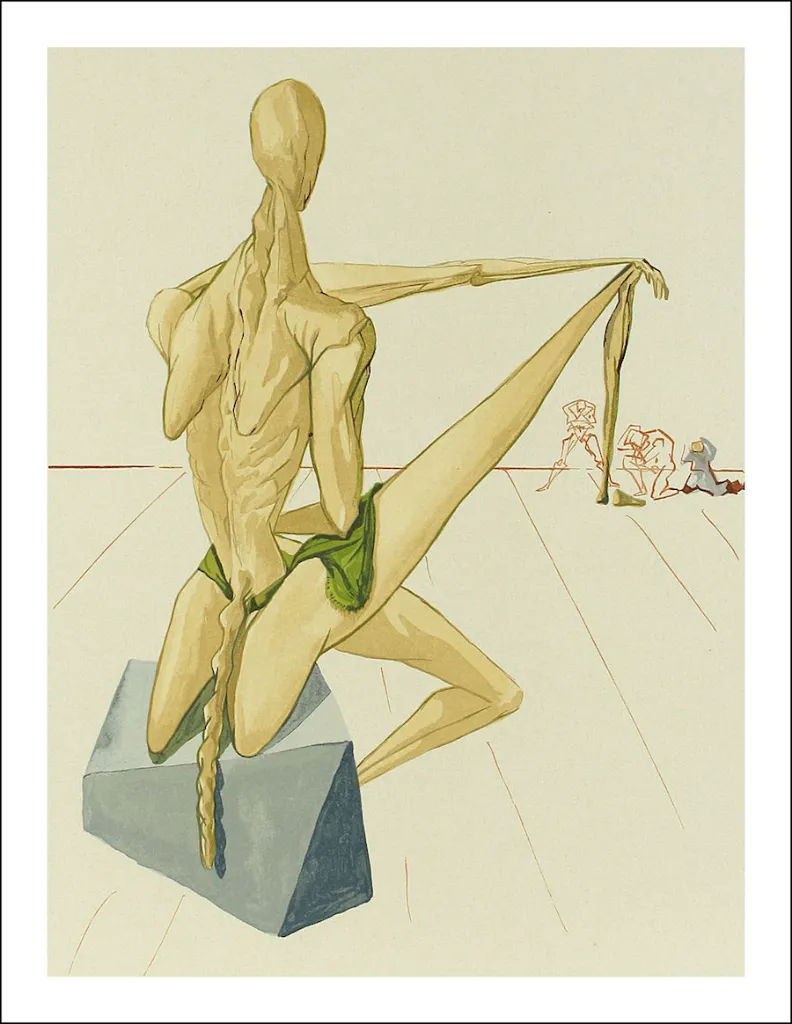
Description
Circle 2 is dedicated to the lustful—those who allowed carnal passion to overpower reason and betray sacred bonds. They are eternally buffeted and whirled by a violent, unending storm that symbolizes the blind, uncontrollable force of desire that swept them away in life, preventing any rest or stability.
Dalí’s illustration shows the monstrous judge Minos, tail coiled to assign each soul’s circle of damnation, standing amid the howling tempest that tosses the lustful shades like starlings in the wind—Hell’s second circle. The demonic figure is twisted and horned, his serpentine tail looping in surreal spirals, while sinuous, melting bodies spiral chaotically around him in Dalí’s feverish, dreamlike style, the entire scene a whirlwind of carnal chaos and restless movement.
Artistic and Social Context
Created within Dalí’s project to illustrate the Divine Comedy, Minos reflects how he reimagined Dante’s terrifying gatekeeper for a modern audience steeped in psychology and surrealism. Dalí fuses the ancient underworld judge with his own visual language of twisted anatomy, theatrical gesture, and ambiguous space, turning the entry to the circle of Lust into a contemporary vision of obsessive desire and inexorable judgment.
Interpretation and Meaning
Dalí’s Minos embodies infallible yet grotesque justice—the coiling tail that assigns fate mirrors the self-deception of the lustful, whose passions twisted their reason; the storm becomes a visual metaphor for the loss of control and the endless unrest that desire without restraint brings to the soul.
Size
The print is about 25.5 × 18 cm (10 × 7 in), consistent with other works in Dalí’s Divine Comedy suite.