The Night Watch
by Rembrandt
Description
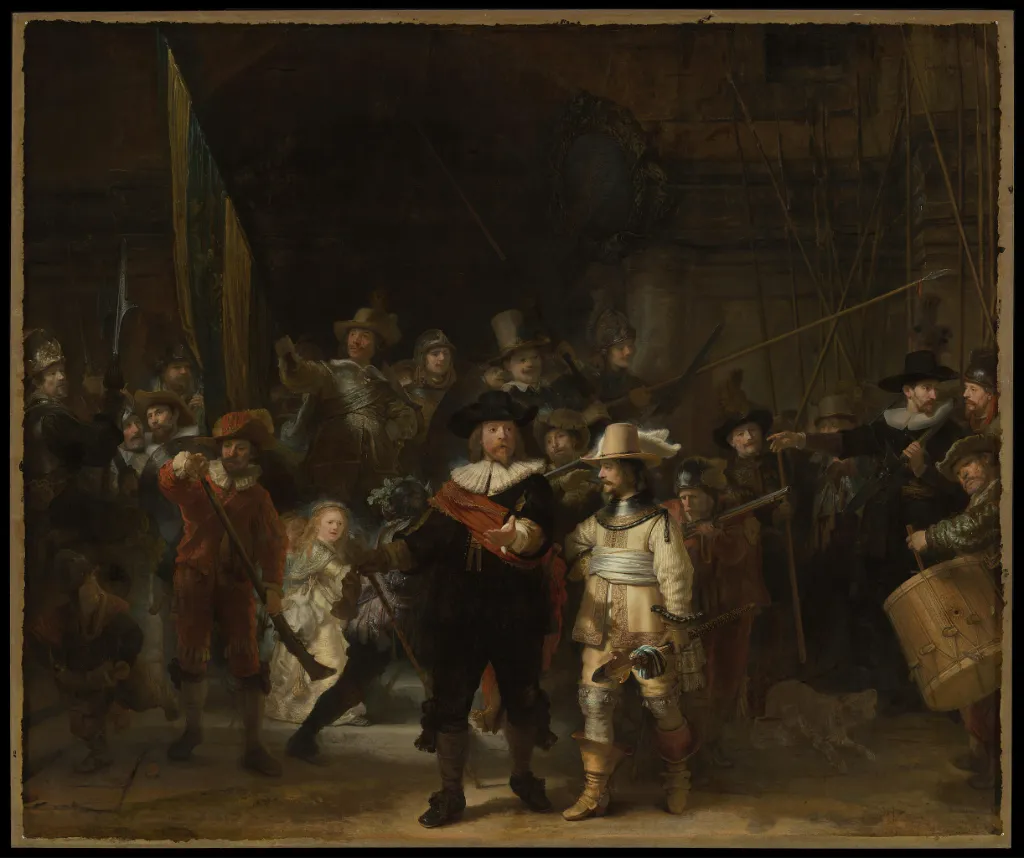
Rembrandt’s The Night Watch (full title: The Militia Company of Captain Frans Banning Cocq) is a large oil on canvas group portrait showing a company of Amsterdam civic guards in action: Captain Frans Banning Cocq in black leads the group, with Lieutenant Willem van Ruytenburch in yellow, as figures emerge from shadow to march forward, drums beating and a girl with a chicken scattering light. Rembrandt uses dramatic chiaroscuro—deep browns and golds—with bold brushstrokes and layered figures to create movement, turning a static lineup into a lively scene of readiness.
Artistic and Social Context
Painted in 1642 for the banquet hall of Amsterdam's Kloveniersdoelen, The Night Watch was Rembrandt's commission from a militia company, blending portrait tradition with action inspired by his studies of light and anatomy. It marked his peak as a portraitist during the Dutch Golden Age, amid trade prosperity and civic pride. Trimmed in 1715 and restored after a 1975 slashing, it's now at the Rijksmuseum since 1808. In culture, it's a Dutch icon of innovation in group portraits, influencing film like The Sting and ads, symbolizing teamwork and heroism in Western art.
Interpretation and Meaning
The Night Watch turns a formal portrait into a story of unity: the burst of light on figures shows emerging action and shared purpose, with the captain's gesture directing energy amid shadows of doubt. The girl's odd role adds mystery, hinting at disruption. It reflects Rembrandt's skill—light for drama, composition for depth—and stands as a study of leadership and fleeting camaraderie.
Size
The original painting measures 363 × 437 cm (11 ft 11 in × 14 ft 4 in); current version after trimming is 319.5 × 379.5 cm (10 ft 6 in × 12 ft 5 in).