Christ in the Storm on the Sea of Galilee
by Rembrandt
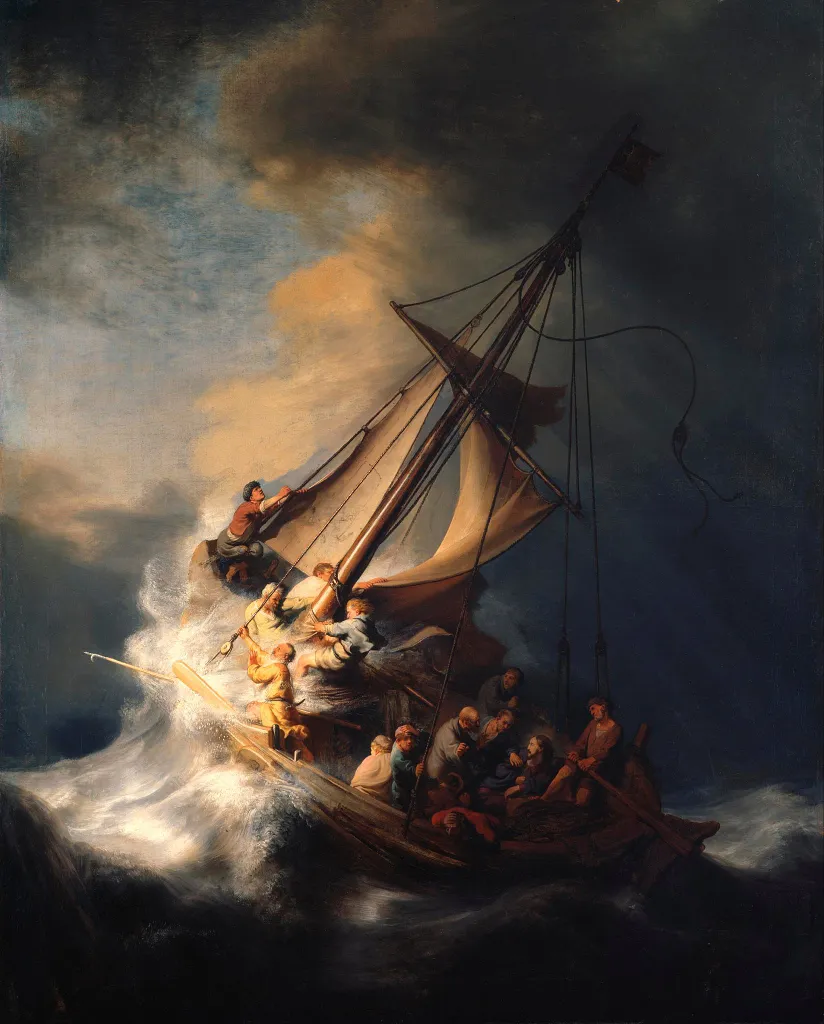
Description
Rembrandt’s Christ in the Storm on the Sea of Galilee (1633) is an oil on canvas depicting eight disciples in panic on a heaving boat during a gale: Christ wakes to calm the waves, one disciple prays, another clings to ropes, with dark skies and foaming sea dominating. Rembrandt applies turbulent brushwork in grays, blues, and whites, with a focused light beam on Christ amid chaos, capturing raw fear and faith in a compact, stormy narrative.
Artistic and Social Context
Created in 1633, Rembrandt's only seascape draws from the Gospel of Mark, painted during his early Amsterdam years after moving from Leiden, influenced by Italian masters like Caravaggio. It reflects 17th-century Dutch interest in biblical drama and maritime life amid global trade. Stolen in 1990 from the Isabella Stewart Gardner Museum (still missing), it was valued at $100 million pre-theft. In culture, it's a key Baroque example of emotion in religious art, echoed in films like The Perfect Storm and storm symbolism, representing human vulnerability and divine intervention.
Interpretation and Meaning
Christ in the Storm shows crisis and rescue: the tilting boat and frantic poses convey terror, contrasted by Christ's serene command over nature, highlighting faith's power over doubt. Rembrandt's self-portrait as a disciple adds personal witness. It captures his technique—light for salvation, motion for turmoil—and endures as a meditation on turmoil and trust.
Size
The original painting measures 160 × 128 cm (63 × 50 3/8 inches).