New York Movie
by Edward Hopper
Description
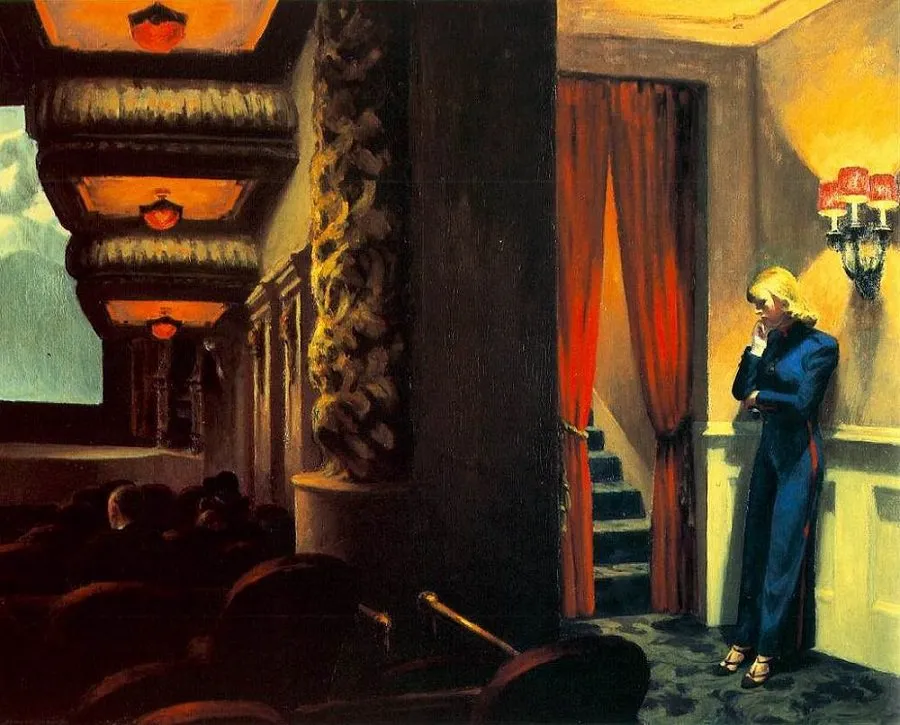
Edward Hopper’s New York Movie (1939) is an oil on canvas painting depicting the dimly lit balcony of a nearly empty cinema: a young usherette in a red dress leans against the wall in thought, while a few patrons sit below watching an unseen film. Hopper employs soft shadows and geometric shapes, with muted reds and golds for the interior against cooler wall tones, creating a split between the screen's glow and the usher's private moment.
Artistic and Social Context
Started in late 1938 and finished in 1939, New York Movie stems from Hopper's sketches of theaters and his wife Jo posing as the usher, tying into his urban isolation themes from Room in New York (1932). It reflects the Great Depression's grip, when movies offered cheap escape, and New York's booming film culture. Owned by the Museum of Modern Art since 1941, it marks Hopper's peak in capturing public spaces. In American culture, it embodies cinema's role in daily life and female labor, inspiring films like Cinema Paradiso and shows such as Mad Men, serving as a symbol of quiet introspection and the divide between entertainment and real emotion in urban America.
Interpretation and Meaning
New York Movie captures personal reverie in a shared space: the usher's daydream amid the film's flicker points to inner escape from routine work, with her isolation from viewers underscoring emotional barriers in crowds. The balcony divide mirrors public-private tensions, where light from the screen highlights disconnection. It reflects Hopper's ideas—light for subtle drama, architecture for human scale—and endures as a study of solitude and fleeting distraction.
Size
The original painting measures 81.3 × 101.9 cm (32 × 40 1/8 inches).