Early Sunday Morning
by Edward Hopper
Description
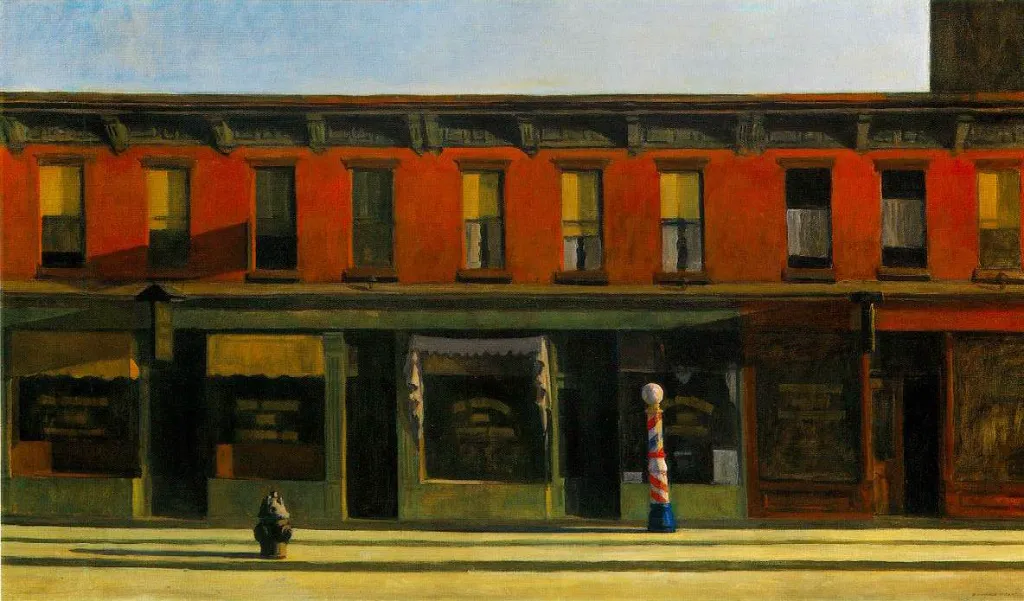
Edward Hopper’s Early Sunday Morning (1930) is an oil on canvas painting portraying the sunlit facades of a row of tenement buildings on a deserted New York street: storefronts and windows line the composition, with subtle signs of life like curtains and a distant fire escape, bathed in morning light. Hopper uses precise horizontals and verticals, with pale yellows and pinks for the walls against deep blue shadows, evoking calm emptiness.
Artistic and Social Context
Painted in 1930 based on Hopper's view of 7th Avenue in Greenwich Village, Early Sunday Morning blends real observation with imagination, echoing his earlier Manhattan Bridge Loop (1928) in urban geometry. It coincides with the Great Depression's onset, showing a still city before economic turmoil hit, and Hopper's shift to American realism. Acquired by the Whitney Museum in 1930, it's a Whitney flagship. For American culture, it defines the "American Scene" genre of everyday city life, influencing street photography, TV like Seinfeld, and urban planning debates, as an enduring emblem of quiet neighborhoods and the poetry in ordinary mornings amid social shifts.
Interpretation and Meaning Early Sunday Morning conveys serene isolation: the empty street and lit windows suggest a pause in urban rhythm, hinting at hidden lives and subtle unease (like a faint painted-over nude figure). Shadows and light build a sense of anticipation and detachment, turning the block into a stage for unspoken stories. It captures Hopper's core—light for revelation, structure for introspection—and remains a meditation on calm before chaos.
Size
The original painting measures 89.2 × 153 cm (35 1/8 × 60 1/4 inches).