19.11.59
by Zao Wou-Ki
Description
Description
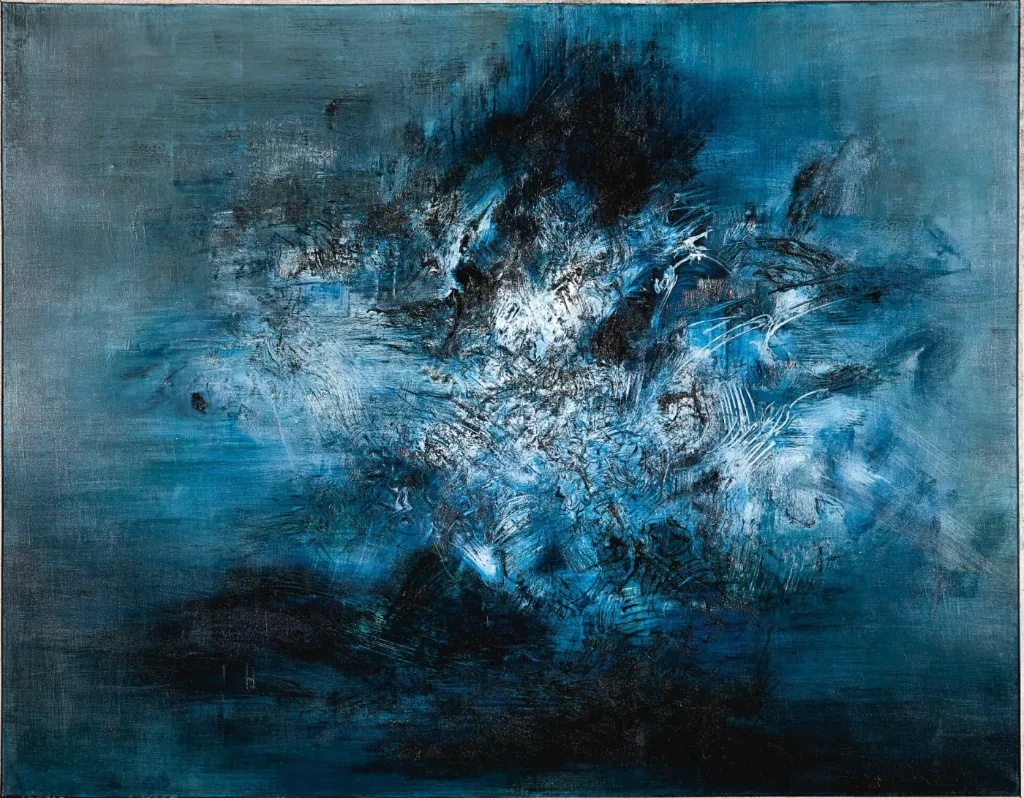
19.11.59 is an oil on canvas work by Zao Wou-Ki, dated 1959. It unfolds as a majestic seascape of ethereal turbulence, where a dignified palette of indigo, Persian blue, cerulean, pale blue, navy, and deep blues blooms across abyssal grounds, animated by black and white linear brushstrokes that surge and intersect in rapid, calligraphic fury. Rendered at the cusp of Zao’s Hurricane Period, the composition channels spontaneous energy through delicate yet bold forms—a central splash-like vortex dominating the plane, evoking primeval forces that float, dance, and circulate the ether, their radiating power evolving into a mysterious, consecrating light amid swirling mists. Signed and dated on the reverse, the painting bears provenance from distinguished collections and is catalogued in the artist’s raisonné, its script-infused abstraction bridging ancient lyricism with modern vigor in a symphony of tonal flux and gestural release.
Artistic and Social Context
Emerging at the threshold of Zao Wou-Ki’s Hurricane Period, 19.11.59 crowns the expressionistic crescendo of his Oracle Bone era (1954–1959), forged amid a transformative 1957–1958 odyssey across North America, Hawaii, Japan, and Hong Kong that dissolved his first marriage and heralded union with Chan May-Kan. This voyage, shadowed by encounters with Abstract Expressionists like Franz Kline, Philip Guston, and Mark Rothko during four pivotal months in New York, ignited a bolder synthesis: American action painting’s raw spontaneity fused with Chinese calligraphy’s lyrical pulse, as gleaned from dialogues with Kyoto’s Bokujin-kai vanguard in 1958. Zao’s annual pilgrimages to New York from 1958–1965 cemented his transatlantic stature, with exhibitions in San Francisco, Sarasota, and beyond; acquired in 1961 by Dr. William E. Upjohn for his pharmaceutical firm’s collection, it graced Michigan’s corporate halls for over four decades before debuting at Sotheby’s Hong Kong in 2020. As Zao reflected in Bokubi: “Characters are one kind of gates... a spot that allows passage between the outside world and my own inner world,” this canvas embodies mid-century’s cultural crossroads, a resilient hymn to hybridity echoed in François Cheng’s verdict: the long-awaited East-West symbiosis realized.
Interpretation and Meaning
The canvas pulses as a portal to primordial awakening, its central vortex—a delicate-bold entanglement of black-white script—incarnating unnamed energies that propel cosmic circulation, birthing luminous veils from indigo depths in a dance of flow and float. Here, oracle bones transmute into gates of passage, per Zao’s vision, where external tempests mirror inner tempests, and calligraphic strokes denote nature’s eternal churn: bloom from void, radiation from repose, the Zhuangzian flux where “safety and danger interchange.” This wellspring of glowing power, delicate yet commanding, consecrates the plane as a rite of renewal—primeval light piercing the hurricane’s breath, evoking ancestral divinations reborn in abstraction’s gale, a meditative summons to harmony amid dissolution, where the artist’s soul merges with the sublime’s unending rhythm.
Size
114 by 146 cm.; 44 7/8 by 57 1/2 in.