21.04.59 (The Cloud Dragon Ascending)
by Zao Wou-Ki
Description
Description
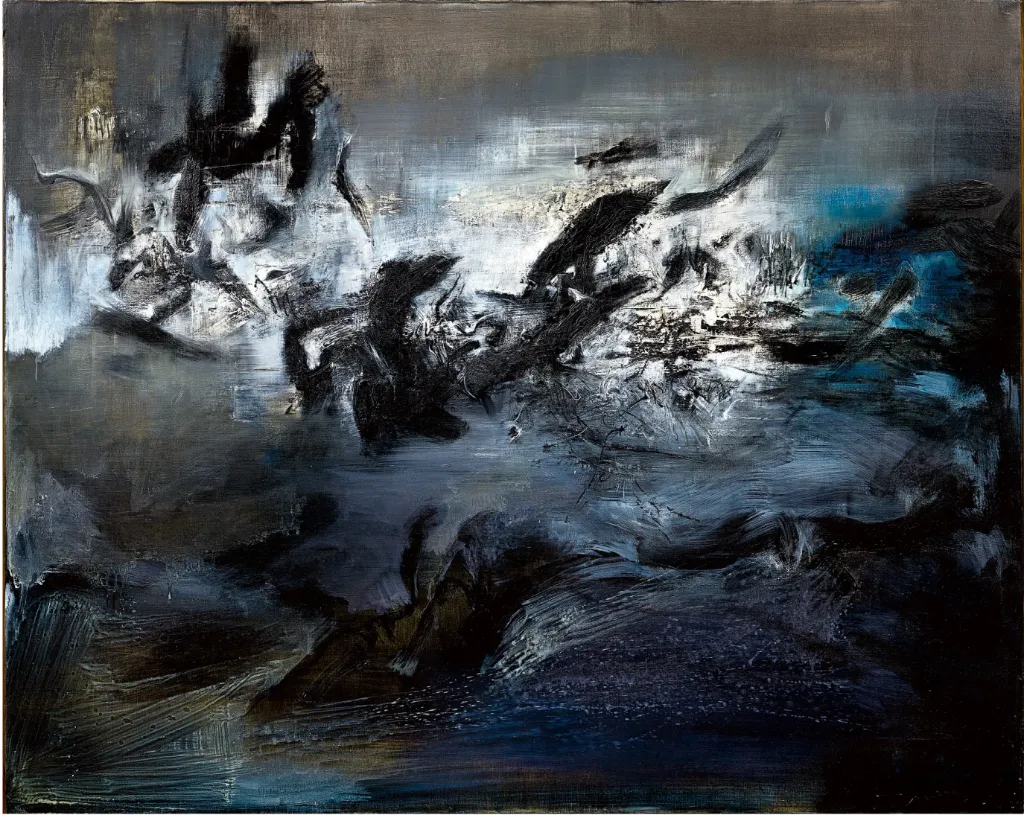
The Cloud Dragon Ascending (21.04.59) is an oil on canvas work by Zao Wou-Ki, dated 1959. It evokes a tumultuous cosmic seascape where a dark, magnificent cloud dragon rolls and spins through abyssal voids, its form rendered in surging blacks, indigo blues, and midnight hues that cascade like an inky torrent, intersected by silvery-gray tendrils and earthen brown accretions reminiscent of archaic inscriptions dissolving into primal energy. Executed in Zao’s seminal fusion of ancient Chinese oracle bone scripts with postwar Western abstraction, the composition unleashes interlocking, heroic brushstrokes that arch and coil in rhythmic fury, forming a grand bow-like silhouette amid flickering forms to symbolize ascending cosmic forces. Signed in Chinese and Pinyin with the date on verso, the painting bears exhibition labels from international institutions and is documented in over 15 catalogs, epitomizing the Oracle Bone Period's zenith through its script-like symbols liberated into autonomous, pulsating vitality.
Artistic and Social Context
Conceived at the apex of Zao Wou-Ki’s Oracle Bone Period (1954–1959), amid the postwar diaspora of cultural hybridity and personal metamorphosis, The Cloud Dragon Ascending emerges from Zao’s 1959 return to Paris following an odyssey through America, Hawaii, Japan, and Hong Kong—a journey sparked by the dissolution of his first marriage in 1957 and culminating in his union with Chan May-Kan. This era's creative surge, fueled by encounters with global abstractionism at its zenith, allowed Zao to transcend direct borrowings from ancestral sources like oracle bone divinations and bronze inscriptions, evolving toward interdependent primitive lines that pulse in self-sustained rhythm. The work, appearing at auction for the first time via Sotheby’s, has graced 16 public exhibitions across Asia, Europe, and South America since the 1970s, its acclaim mirroring Zao’s rise as a transnational figure whose Oracle Bone Series now anchors collections at The Art Institute of Chicago and The Solomon R. Guggenheim Museum, embodying mid-century resilience through art's bridge across fractured identities.
Interpretation and Meaning
The canvas incarnates a mythic ascent, as articulated in Chen Rong’s ancient verse: "Ascending to the galaxies, reaching the Hua and Song Mountains. Rain nourishes far and wide, it cultivates immortality. Riding on the energy of the cosmos, it travels through the sky." Here, the cloud dragon—heroic and unbound—dances in a torrent of color and light, its turbid strokes entangling like serpentine script to intimate the cosmos’s eternal renewal, where "safety and danger interchange, misery leads to happiness and vice versa, gentleness and urgency press each other on, congregation makes dispersion and vice versa" (Zhuangzi). Amid a bottomless noir ocean, indigo mists part for auspicious "purple mist from the East" and fleeting silvers, forging a yin-yang dialectic of peril and grace: forms that leap, clash, and disperse in vast life energy, capable of birthing universes. This heroic, masculine inner landscape—evoking Chen Rong’s Nine Dragons—disassembles identity for rediscovery, the artist merging with the sublime to exalt ephemerality’s poetry, where abstraction unveils the universe’s riddle of flux and harmony.
Size
Listings confirm a monumental rectangular format, precisely 130 × 162 cm, unframed in original state. Variations may arise from mounting or exhibition contexts.