A Stone Bridge in Jiangnan (水乡石桥 Shuǐxiāng Shíqiáo)
by Wu Guanzhong
Description
Description
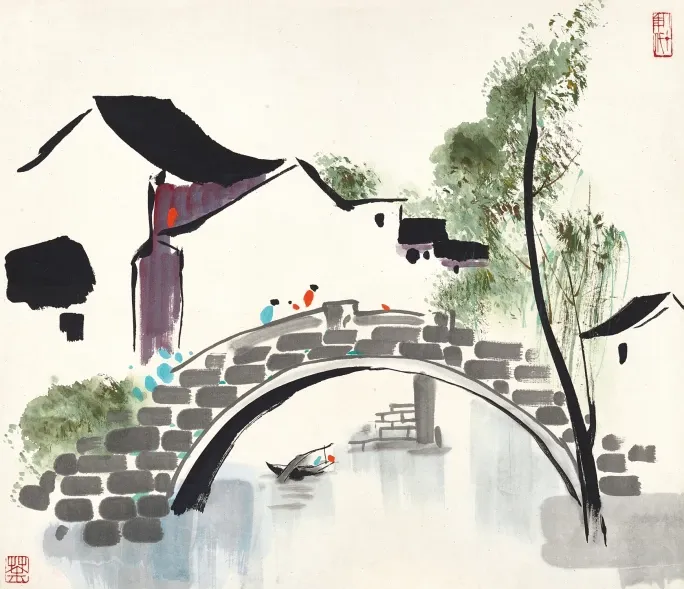
Wu Guanzhong’s A Stone Bridge in Jiangnan (水乡石桥 Shuǐxiāng Shíqiáo, 1985) is an ink and color on paper painting featuring an iconic arched stone bridge nestled in the lush waterways of southeastern China. Rounded bridge forms curve gracefully over shimmering water, their reflection rendered in lively, abbreviated lines. Interwoven willow branches and elegant village houses frame the bridge in a tapestry of black, emerald, and ochre, with Wu’s swift brushstrokes animating both structure and setting. The composition foregrounds harmonious contrasts—rigid stone and soft foliage, curve and straightness, solid silhouette and negative space—to evoke the Jiangnan region’s poetic tranquility and dynamic life.
Artistic and Social Context
Painted in 1985, this work exemplifies Wu’s mature style, where he blends Western abstraction with Eastern ink traditions to modernize the visual language of Chinese landscape. Bridges recur throughout Wu’s oeuvre as motifs of connection—linking not only physical spaces, but also China’s artistic past to its present and the synthesis of Eastern and Western cultural ideals. In the 1980s, as Wu was recognized as one of modern China’s most innovative landscape artists, his focus on familiar subjects like Jiangnan’s bridges became meditations on memory, heritage, and personal renewal, reflecting a broader national quest for continuity amidst transformation.
Interpretation and Meaning
The arched bridge symbolizes passage, unity, and the enduring relationship between the natural and human-made. Graceful willows evoke lyrical melancholy, while the bridge itself stands for resilience and hope. Wu’s animated lines and flowing composition turn a serene river view into a larger metaphor for life’s journey—full of ups and downs, crossings and connections. The absence of people invites viewers to project themselves into the scene, contemplating their own path across shifting water and time. The painting thus embodies Wu’s belief that the beauty of form is inseparable from the poetry of the human spirit and the timeless soul of Jiangnan.
Size
The original framed work measures approximately 41.6 × 48.5 cm (16⅜ × 19⅛ in).