A Garden in Suzhou (苏州园林 Sūzhōu Yuánlín)
by Wu Guanzhong
Description
Description
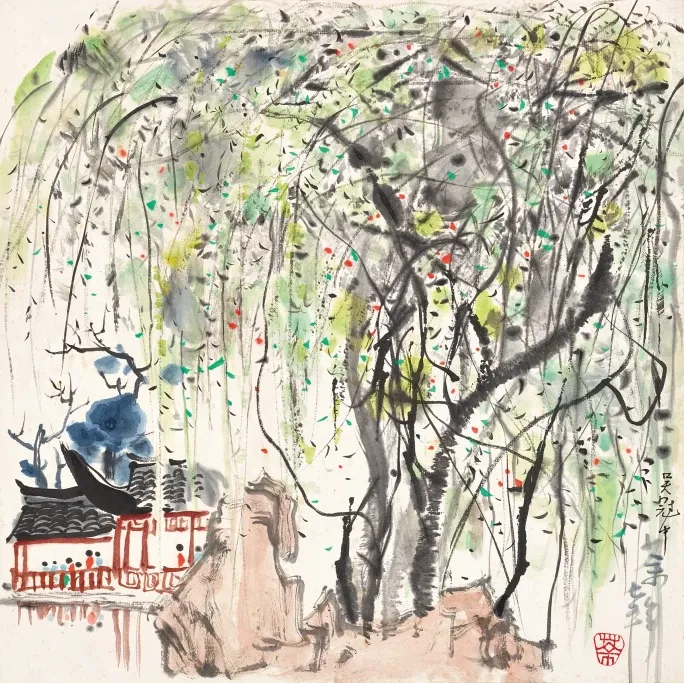
Wu Guanzhong’s A Garden in Suzhou (苏州园林 Shuǐxiāng Shíqiáo, 1975) is an ink and colour on paper painting, distinguished by its semi-abstract approach to the classical Chinese garden. The work centers on a mass of rhythmic rooflines and white-washed walls, their graphic zigzags echoing both the intricate geometry of traditional pavilions and the lyrical movement of nature. A flowering tree, rendered in expressive dabs of green, yellow, and red, bursts over an artificial rock, its delicate branches trailing across the composition. Dappled washes and staccato dots animate the garden’s springtime vibrancy, while restrained grey tones suggest stone and shadow, harmonizing architecture with organic abundance. Wu’s dynamic brushwork and interplay of positive and negative space fuse tradition and modernity, abstraction and description.
Artistic and Social Context
Created in 1975, A Garden in Suzhou belongs to Wu Guanzhong’s formative series on Jiangnan gardens, made after his return to painting following political upheaval in China. He drew inspiration from Suzhou’s world-famous literati gardens—icons of cultural memory and scholarly idealism—while pioneering a distinctly modern vision rooted in the expressive freedom of Western art. Wu’s technique of layering washes and color dots on ink structures symbolized a dialogue between old and new, and between the individual artist and historical legacy. The focus on a blooming tree foregrounds nature’s renewal and personal resilience, both key themes for Wu and for China’s evolving society during the 1970s.
Interpretation and Meaning
This painting transforms Suzhou’s elegance into an emotional landscape: the interplay of blooming branches and strong architectural lines evokes the artist’s belief in the harmony of nature and human creativity. The vibrancy of spring—captured in the tree’s animated hues and flowing forms—suggests hope, restoration, and the continuous cycle of life. By minimizing human figures, Wu places emphasis on the lived spirit of place and the meditative encounter between viewer and environment. The result is a visual poem: at once rooted in Chinese tradition and refreshed through innovation, a testament to beauty’s power to endure and adapt.
Size
The original work is framed, measuring approximately 35 × 35 cm (13.8 × 13.8 in)