Le café Maure (Arab Coffeehouse)
by Henri Matisse
Description
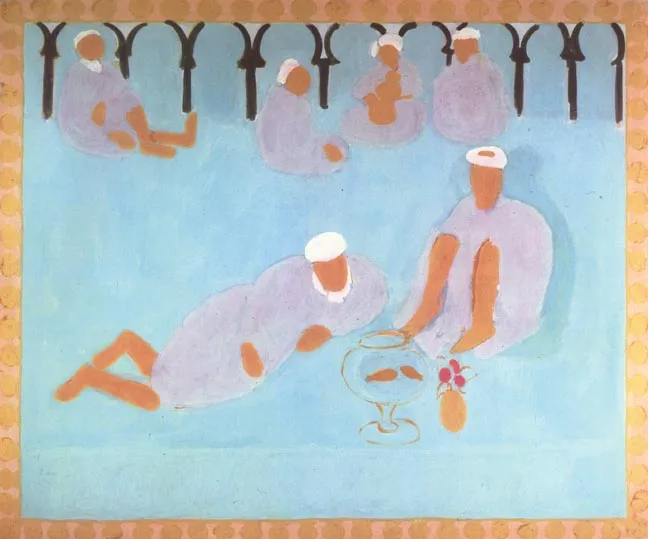
Henri Matisse’s Arab Coffeehouse (Le café Maure, 1912–1913) is a large oil on canvas painting depicting contemplative Moroccan figures seated in a traditional coffeehouse, gathered around a central glass aquarium with goldfish against a fluid turquoise interior framed by architectural arches. The stylized figures in soft grays and warm ochres, rendered with simplified forms and curving outlines, capture a profound sense of serenity and absorption through harmonious color contrasts and abstract spatial dissolution. The composition envelops the viewer in a watery, dreamlike realm, presenting the scene as a celebration of meditative tranquility and cultural immersion.
Artistic and Social Context
Painted in 1912–1913 during Matisse's second trip to Morocco and shortly after, Arab Coffeehouse draws from the artist's observations of locals entranced by goldfish in bowls, forming part of his Moroccan cycle and recurring goldfish motif series. Representing a maturation of Fauvism through expressive simplification and ornamental exuberance inspired by Islamic art, the work reflects early 20th-century European Orientalism and Matisse's escape to North Africa for artistic renewal. Commissioned and acquired by Russian collector Sergei Shchukin in 1913 for his Moscow mansion, it later entered the Hermitage Museum collection following Soviet nationalization in 1948, underscoring its role in bridging modernist innovation with exotic cultural fascination.
Interpretation and Meaning
Arab Coffeehouse evokes absolute inner peace and contemplative ecstasy through its circular motifs and turquoise palette, transforming the coffeehouse into a metaphor for paradise lost and serene detachment from the physical world. The goldfish aquarium and distant musical instrument anchor the figures' profound attention, symbolizing life's fluid cycles, emotional harmony, and the restorative power of reverie. The painting embodies modernism's essence—color as meditative force, form as introspective unity—and endures as an icon of Matisse's ability to fuse cultural observation with spiritual abstraction.
Size
The original painting measures 176 × 210 cm (69 × 83 inches)