L’Atelier rouge (The Red Studio)
by Henri Matisse
Description
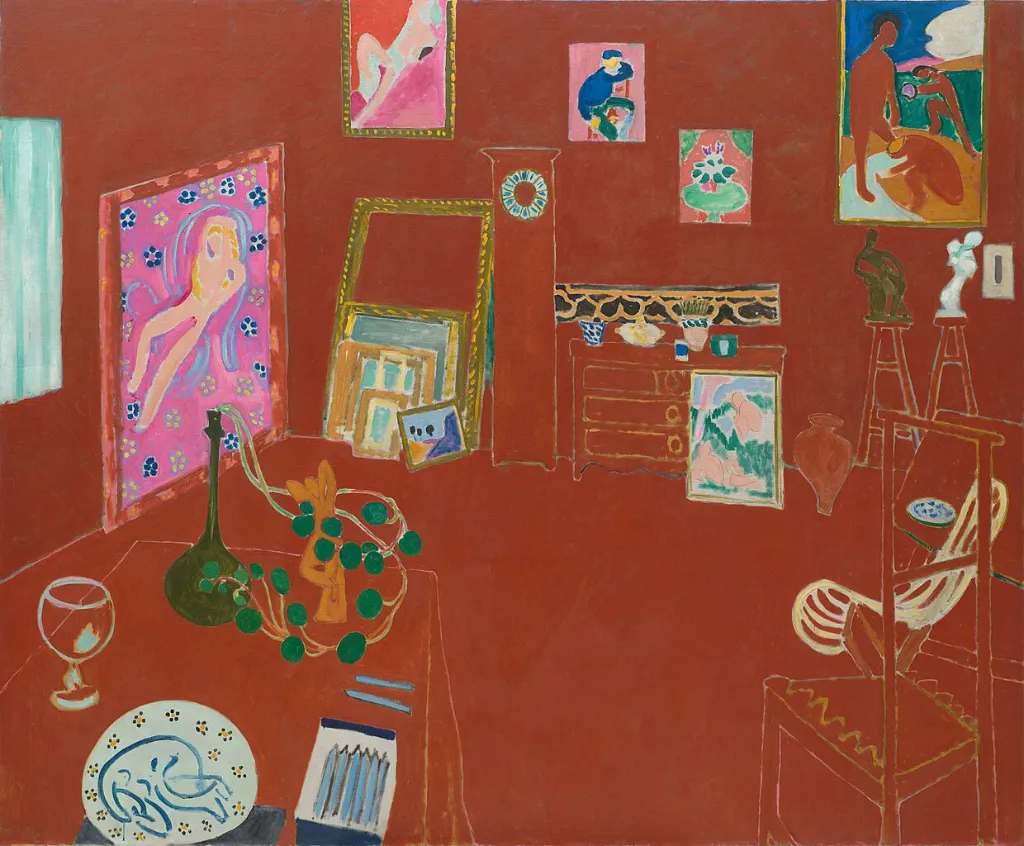
Henri Matisse’s L’Atelier rouge (The Red Studio, 1911) is an oil on canvas painting featuring the artist’s studio drenched in a flat, vibrant red that dominates the entire space. Within the red interior, outlined in subtle orange and yellow, are paintings, sculptures, and furniture rendered with simplified forms and bright contrasting colors, creating an abstracted yet intimate view of the artist’s creative environment. The composition blends the real and imaginary, juxtaposing the flatness of the red field with detailed objects framed in the studio.
Artistic and Social Context
Painted during Matisse’s mature Fauvist period, L’Atelier rouge exemplifies his interest in color as an autonomous element that shapes spatial perception. The work emerged amid his evolving approach to abstraction, where color simplifies and energizes space without strict adherence to perspective or realism. It reflects the artist’s role in the Parisian avant-garde and his desire to integrate art, environment, and imagination into a unified experience, influencing later developments in modern art such as Abstract Expressionism.
Interpretation and Meaning
L*’Atelier rouge* transforms the artist’s workspace into a poetic, symbolic realm, where the conventional spatial logic is replaced by chromatic resonance and emotional depth. The red serves as a unifying field that both contains and liberates the objects, suggesting the intensity of artistic creation and the intimate world of the artist. The painting invites viewers into a contemplative engagement with the creative act itself, transcending representation to evoke a sense of energy and harmony.
Size
The original painting measures 162 × 130 cm (63.8 × 51.2 inches).