Les Poissons rouges (Goldfish)
by Henri Matisse
Description
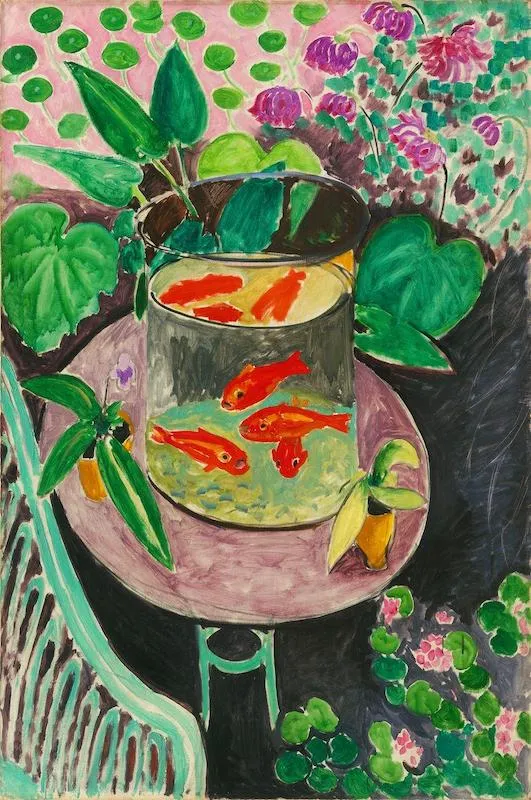
Henri Matisse’s Les Poissons rouges (Goldfish, 1912) is an oil on canvas still life focusing on a cylindrical glass aquarium holding four vibrant orange goldfish, placed atop a circular pink table surrounded by lush green plants and decorative foliage. The lively contrast between the fish and their environment is further heightened by the use of bright, saturated colors—greens, pinks, and purples frame the calm water and shimmering fish, blending indoor garden elements with a bold Fauvist palette and fluid contours.
Artistic and Social Context
Painted in Matisse’s garden conservatory at Issy-les-Moulineaux following his 1912 journey to Morocco, Goldfish reflects his fascination with quiet contemplation and the relaxed, meditative state he observed among Moroccans who gazed at goldfish bowls. This work, part of a broader series of goldfish-themed paintings from that year, exemplifies Matisse’s evolution from Fauvism into a more decorative, serene, and psychologically rich art, while maintaining an intense commitment to pure color and compositional balance. Featuring his own houseplants and garden furniture, the painting also acts as a personal vision of paradise and creative retreat.
Interpretation and Meaning
Les Poissons rouges invites viewers into a constructed world of tranquility and visual pleasure, symbolizing contemplation, harmony, and creative sanctuary. The aquarium’s dual perspective—allowing fish to be seen both frontally and from above—creates a spatial tension that encourages meditation on perception and artistic vision. The goldfish, luminous and idyllic, serve as emblems of restorative beauty and imaginative escape within an urbanized modern world.
Size
The original painting measures approximately 147 × 98 cm (about 58 × 39 inches).