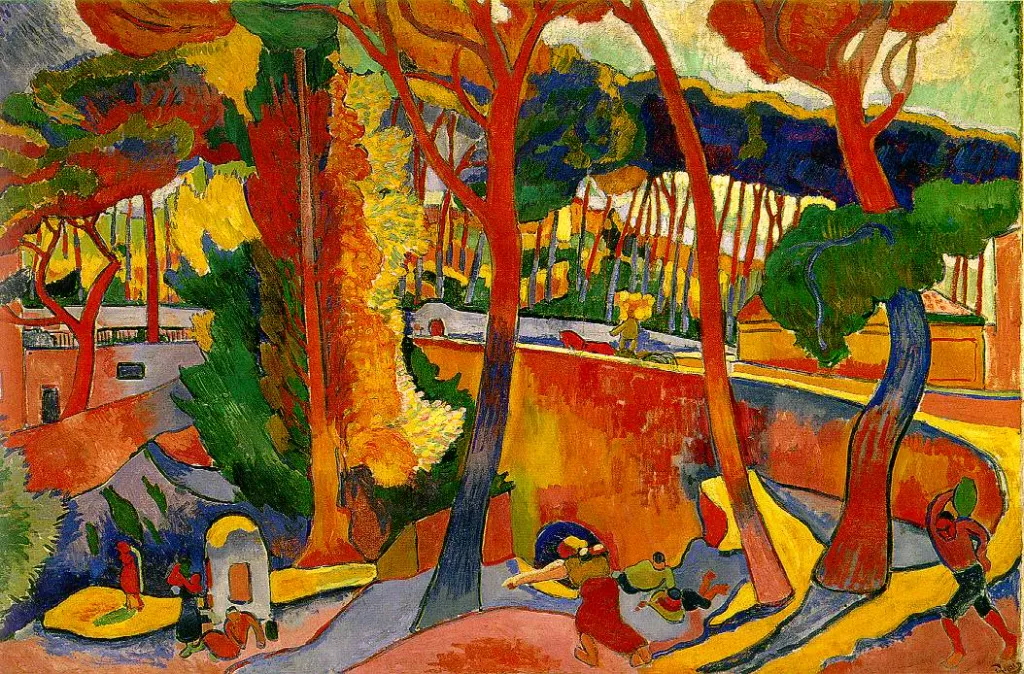
Le Chemin Tournant à L'Estaque (The Turning Road, L’Estaque)
by André Derain
Description
André Derain’s Le Chemin Tournant à L'Estaque (The Turning Road, L’Estaque, 1906) is a monumental oil on canvas bursting with vivid color and energetic forms. The composition features fiery red, orange, and yellow trees framing a curving road, with simplified, faceless figures and flat color patches animating the landscape. The sun-soaked village and pine woods of L’Estaque are rendered in bold, decorative brushstrokes, emphasizing movement and light with intense, unmodulated hues and expressive contours.
Artistic and Social Context
Painted during the summer of 1905–1906 in southern France, this masterpiece marks the height of Derain's Fauvist period. Working alongside Henri Matisse, Derain helped pioneer Fauvism with dramatic color applications that broke with Impressionist convention, rejecting local color for pure and arbitrary tones. The work was featured in the famed Salon d'Automne of 1905, drawing both acclaim and controversy and earning the Fauves their wild "beastly" moniker. Its location, L’Estaque, was already celebrated by Cézanne, but Derain reimagined its landscape with radical abstraction and a modernist sense of fantasy.
Interpretation and Meaning
Le Chemin Tournant à L'Estaque is not just a depiction of nature but a celebration of artistic liberty, where color and form evoke emotional resonance over realistic imitation. The blazing trees and playful figures suggest both joy and abandon, transforming the everyday into a decorative vision. Its simplified lines and faceless forms emphasize the collective and universal, while the curved road and dynamic composition suggest progress, possibility, and the energetic pulse of modern life.
Size
The original painting measures 148 × 214.8 cm (58 1/4 × 84 9/16 inches).