Paysage aux environs de Chatou (Landscape near Chatou)
by André Derain
Description
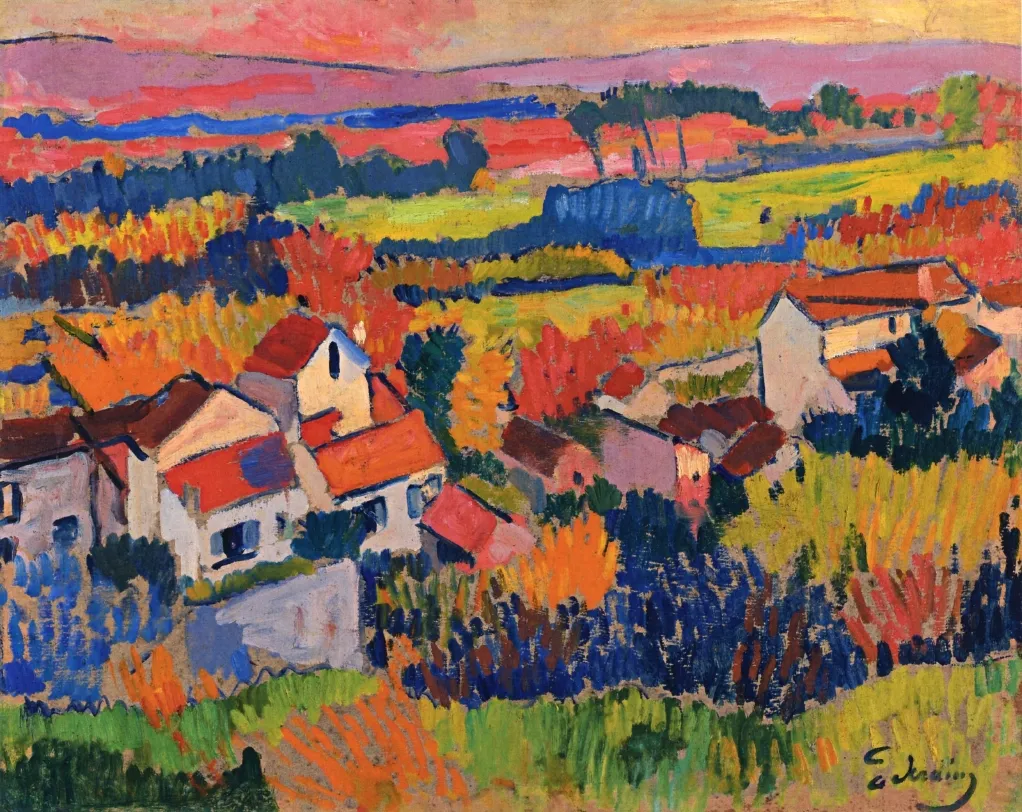
André Derain’s Paysage aux environs de Chatou (Landscape near Chatou, 1904) is an oil on canvas painting that vibrantly depicts a semi-rural landscape with red-roofed houses nestled among explosions of color representing fields, trees, and distant hills. Energetic, short brushstrokes in vivid hues—orange, blue, yellow, and green—convey autumnal foliage and cultivated ground, while the sky and horizon glow with pinks and purples. The viewpoint from a hill and the tightly grouped architecture highlight the harmony between human habitation and the countryside through abstracted, colorful forms.
Artistic and Social Context
Painted in 1904, this work represents a pivotal moment in Derain’s career, just before the birth of Fauvism. At this time, Derain, having completed military service, was painting regularly with Maurice de Vlaminck in Chatou, a Parisian suburb favored by earlier Impressionists. Their experimentation with intense color and expressive brushwork was further encouraged by Matisse, who championed their participation in the influential 1905 Salon des Indépendants. “Landscape near Chatou” reflects early Fauvist tendencies through its liberated palette and approach to landscape, while also showing the influence of Cézanne in the structured, elevated viewpoint and nods to Post-Impressionist technique.
Interpretation and Meaning
Paysage aux environs de Chatou emphasizes the power of pure color and rhythmic brushwork to capture place, season, and atmosphere rather than exact detail. The painting invites viewers into an immersive world where the energy of nature and the built environment are inseparable. The flattened perspective and bold colors transform the familiar landscape into a celebration of perception and artistic freedom, marking Derain’s belief in painting as both sensation and structure.
Size
The original painting measures approximately 54.6 x 65.9 cm (about 21 1/2 x 26 inches)