Nature Morte (Still Life)
by André Derain
Description
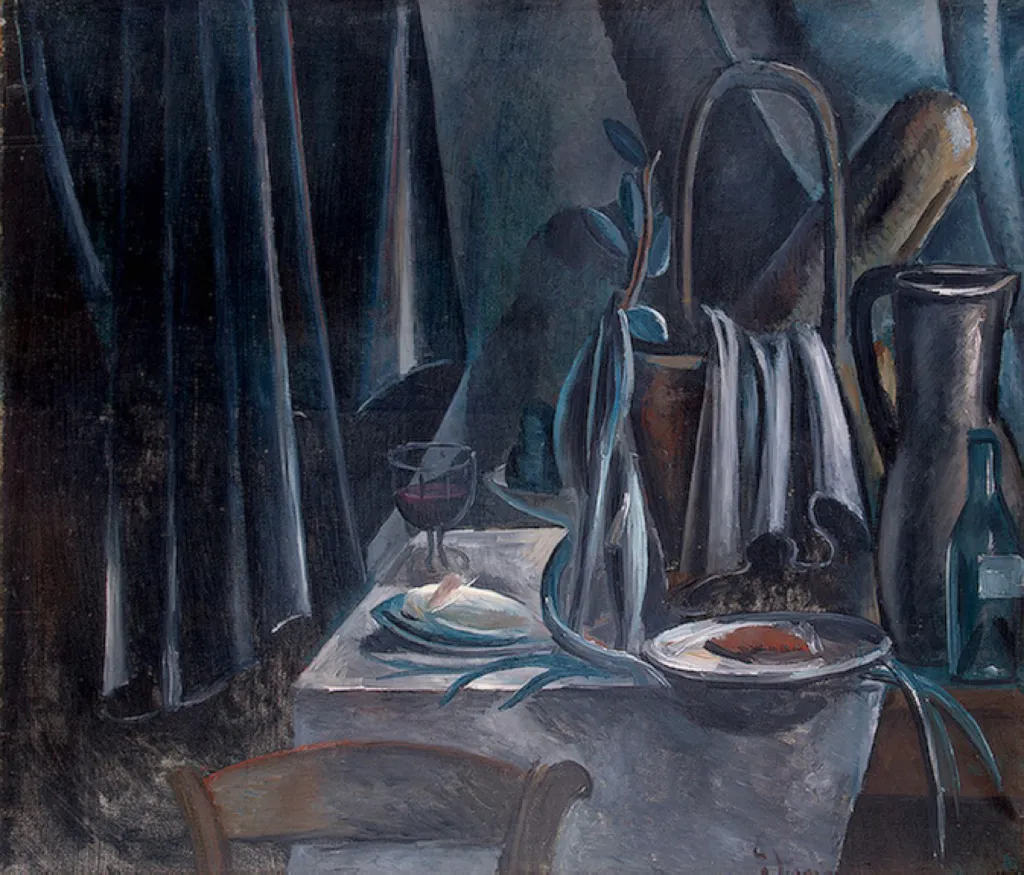
André Derain's Nature Morte (Still Life) (1912) is an oil on canvas painting depicting a moody, composed interior scene with a table holding a vase with leafy branches, plates of food, a wine glass, and various vessels arranged in front of a dark, draped background. The muted, cool palette with blue-gray hues and the controlled brushwork highlight form, shadow, and volume, contributing to a contemplative atmosphere. The painting integrates the everyday objects in a structured composition with a subtle play of light and texture.
Artistic and Social Context
Created in 1912, this work belongs to Derain’s Cubist period, reflecting his transition from Fauvism to the analytical explorations of Cubism alongside contemporaries like Picasso and Braque. The painting was made during a pivotal moment in early 20th-century art when traditional representation was being radically rethought, focusing on geometric forms and multiple perspectives. Exhibited and reproduced in significant Cubist publications of the time, it manifests Derain's engagement with the intellectual avant-garde and abstract structuralism in Paris.
Interpretation and Meaning
Nature Morte emphasizes the stillness and quiet dignity of commonplace objects through geometric simplification and muted colors. The arrangement of objects like the loaf of bread, bottles, and plates suggests domestic life but is abstracted to focus on form and spatial relationships. The painting invites meditation on everyday beauty and the materiality of objects, reflecting Cubism’s broader investigation of perception and reality.
Size
The original painting measures 100.5 x 118 cm (39 1/2 x 46 1/2 inches).