Bamboo and Rock
by Yun Shouping
Description
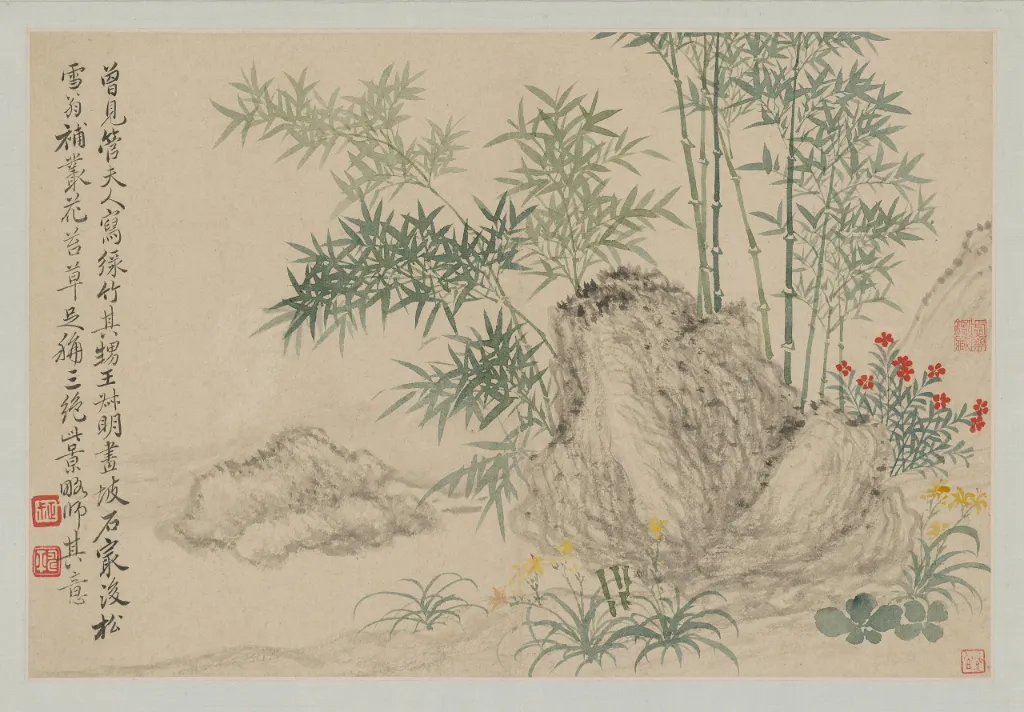
Yun Shouping (1633–1690)'s Bamboo and Rock (Zhushi) (ca. 17th century, leaf from Album of Flowers) is an ink and color album leaf portraying elegant bamboo stalks with flowing green leaves emerging behind craggy, textured rocks, accented by clusters of delicate red azaleas and yellow narcissus blooming at the base amid sparse grasses, rendered in subtle washes and fine brushwork blending outline and boneless techniques for a serene, naturalistic composition.
Artistic and Social Context
Painted in the Qing dynasty (1644–1912), this work highlights Yun’s versatility in bridging floral elegance with landscape elements, informed by his merchant roots and scholarly aspirations denied by exam restrictions, fostering a focus on personal, emotive art. Drawing from Song-Yuan traditions while innovating with light color applications, it belongs to his renowned Album of Flowers, circulated among literati like the Changzhou School peers, incorporating inscriptions and seals to intertwine poetry, calligraphy, and imagery as tools for cultural and moral discourse in the evolving Qing artistic milieu.
Interpretation and Meaning
Bamboo and Rock embody Confucian ideals of upright integrity and unyielding resilience—the bamboo's flexibility in adversity, the rock's immovability—enhanced by the azaleas' vibrant passion and narcissus' modest renewal, collectively symbolizing harmonious virtue amid life's flux. Yun’s "feeling taking" (qu qing) infuses the palette with gentle greens for vitality, vivid reds for fleeting joy, and soft yellows for quiet hope, the layered washes evoking contemplative balance: the bamboo's sway invites reflection on adaptability, the rocks' solidity on endurance, and the blooms on nature's poetic transience.
Size
The original size of Yun Shouping’s Bamboo and Rock is 29.2 × 24.6 cm (11 1/2 × 9 11/16 inches).