Peonies
by Yun Shouping
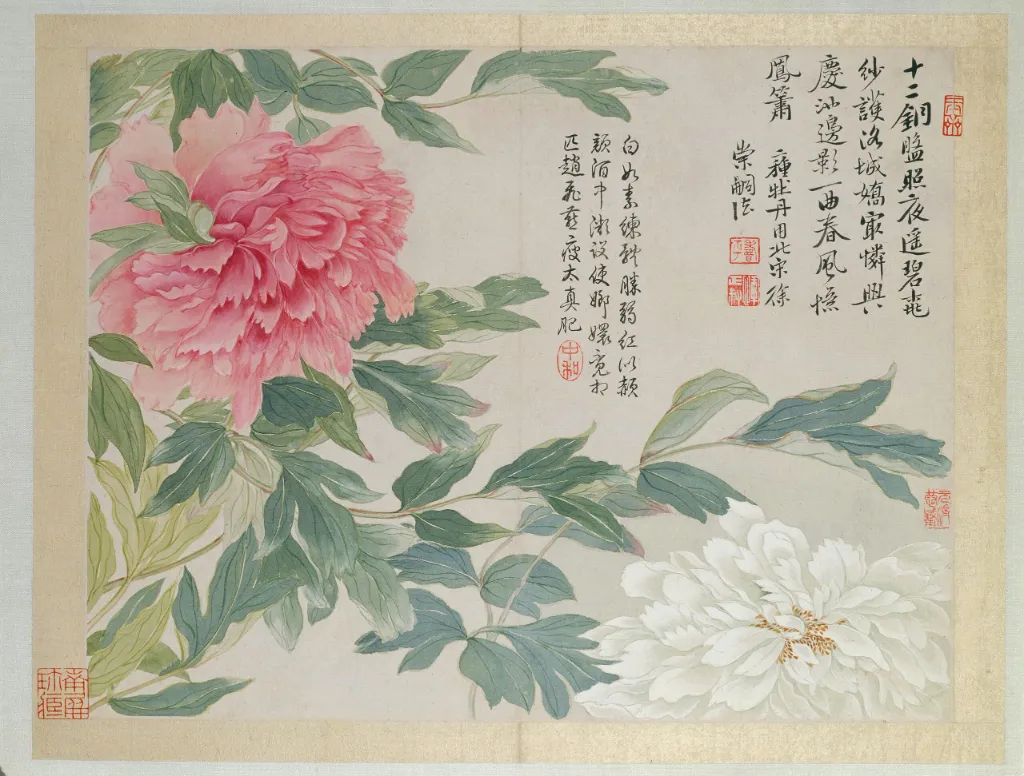
Description
Yun Shouping (1633–1690)'s Peonies (ca. 17th century, second leaf from Album of Flowers and Landscapes) is an ink and color album leaf showing two blooming peonies in the boneless (mogu) style, using color washes without outlines. A pink peony appears on the left with layered rose petals and green leaves, paired with a white peony on the right, its form highlighted by yellow stamens. Reds, greens, and whites mix smoothly, depicting spring blooms in a balanced composition.
Artistic and Social Context
Painted in the Qing dynasty (1644–1912), this work reflects Yun’s development as a literati artist from a modest background that excluded him from civil exams. It shows his move from landscapes—influenced by Wang Hui—to flower painting, reviving the boneless technique from 11th-century artist Xu Chongsi. The album, shared with peers like Wang Hui, combines poetry, calligraphy, and painting, as evident in its inscriptions and seals. It highlights Yun’s role in the Changzhou School, mixing old methods with new ideas to advance flower-and-bird art for moral and aesthetic purposes in early Qing culture.
Interpretation and Meaning
Peonies depicts nature’s brief beauty and symbolizes prosperity, virtue, and transcendence, with peonies representing wealth, honor, and grace in Chinese tradition. The colors—rich but restrained—align with Yun’s "feeling taking" (she qing) approach, adding emotional layers: a hidden purplish-brown bloom for resilience, upward dark red for vitality, and fading white for reflection. The washes connect the physical world to inner balance, prompting thoughts on impermanence and cultural value.
Size
The original size of Yun Shouping’s Peonies is 28.5 × 43.0 cm (11 1/4 × 16 15/16 inches).