Self-Portrait with Seven Fingers
by Marc Chagall
Description
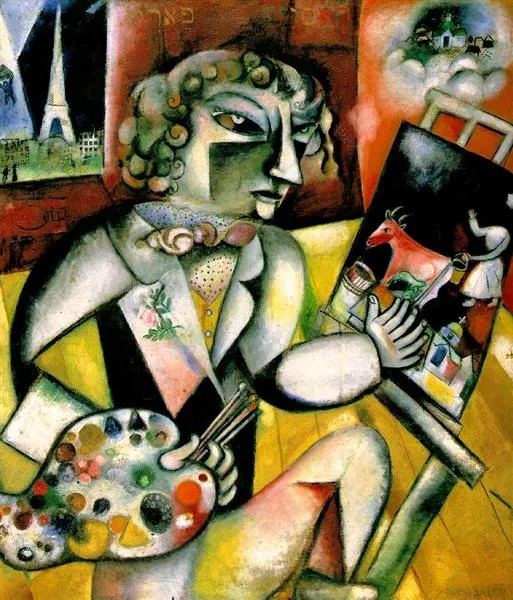
Marc Chagall’s "Self-Portrait with Seven Fingers" (1912–13) is a visionary oil painting and the artist’s iconic first self-portrait. The scene is a dazzling psychological collage: Chagall paints himself at his easel in a yellow-toned studio, his face turned toward the viewer in a moment of profound introspection. The most surreal detail emerges immediately—his left hand holds a palette with seven elongated fingers, a fantastical gesture alluding to the Yiddish idiom for working “with all seven fingers,” meaning with utmost intensity and creative vigor. Around him, symbols of his life and longing abound: to the left, the Eiffel Tower peeks through a window, signaling his new home in Paris; to the right, the rooftops of Vitebsk and a village church float in a dreamlike vapor, reflecting nostalgia for his Russian-Jewish roots. Chagall renders himself painting a canvas-within-a-canvas, "To Russia, Donkeys and Others," intertwining memories of homeland with the present act of creation. The painting’s fractured, Cubist-inspired planes and radiant, warm palette—yellows, reds, browns—amplify the energy of this self-portrait as a mythic tableau of identity, migration, and artistic transformation.
Artistic and Social Context
Executed at La Ruche in Paris when Chagall was 25, "Self-Portrait with Seven Fingers" fuses avant-garde French influences with Russian folk imagery. The seven fingers on Chagall’s left hand serve both as a nod to his relentless creative drive and as a talismanic invocation of luck and mystical significance (seven is auspicious in Jewish tradition and marks Chagall’s date of birth). The painting reflects Chagall’s early fascination with Cubism’s geometric structures, which he infuses with lyricism, symbolism, and personal mythology. Seen through the lens of exile, ambition, and cultural hybridity, the portrait becomes an act of self-invention—Chagall proclaims his place as a painter carrying the memories of his shtetl into the cosmopolitan Parisian art world.
Interpretation and Meaning
By merging elements of Russian folk life, Jewish heritage, Parisian modernism, and personal myth, Mourlot 501 becomes a meditation on identity, longing, and the artist’s doubled existence. The seven fingers dramatize Chagall’s claim to inventive prowess and relentless effort, while the split background and simultaneous references locate him between two homes, two cultures, and multiple artistic languages. The doubling, Cubist dislocations, and inscribed Hebrew words ("Paris" and "Russia") evoke a world in flux, where the self is an ongoing creative negotiation.
Size
Canvas size: approx. 127 x 107 cm (50 x 42 in).