Transfiguration
by Raphael
Description
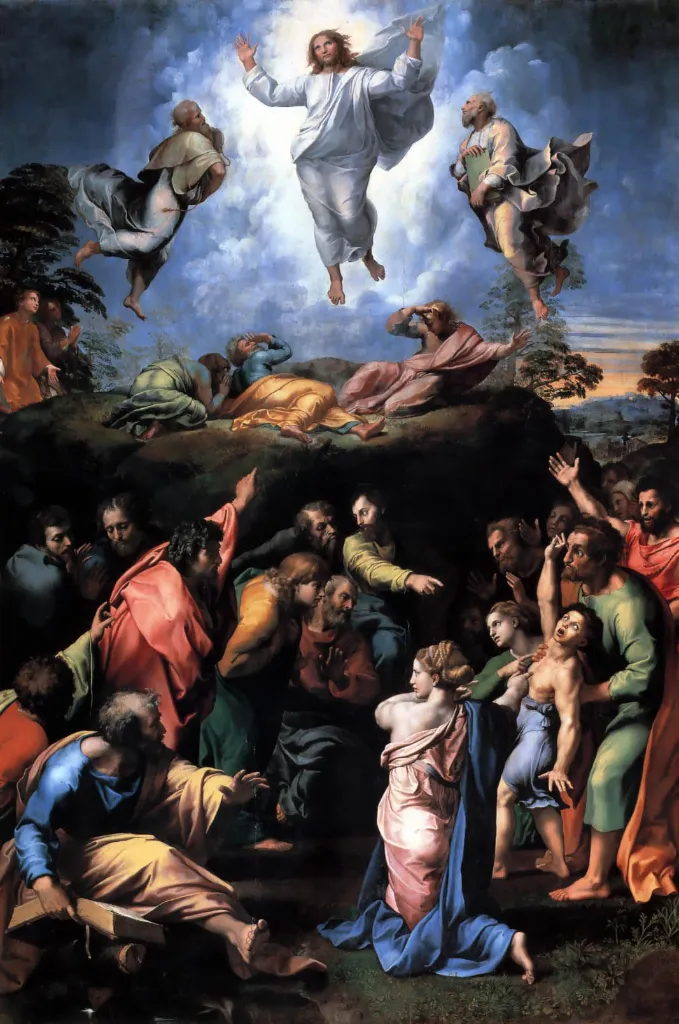
Raphael’s Transfiguration (1516–1520) is a monumental oil painting that illustrates the biblical event of the Transfiguration, where Christ is transformed on Mount Tabor, radiating divine glory before his disciples. In the upper register, Christ ascends in brilliant light, flanked by Moses and Elijah, embodying the very meaning of transfiguration—a dramatic change into a more glorious form. Below, the tumult of a possessed boy and the desperate gestures of those around him stand in stark contrast to the serenity above. By uniting these two scenes, Raphael creates a composition that fuses spiritual revelation with the struggles of human existence.
Artistic and Social Context
Commissioned by Cardinal Giulio de’ Medici (later Pope Clement VII) for the cathedral of Narbonne, Transfiguration was Raphael’s last great work, completed after his death in 1520 by his workshop. It reflects the balance, grandeur, and clarity of the High Renaissance while foreshadowing the heightened drama of Mannerism. First displayed at Raphael’s funeral in Rome, the painting became a symbol of his artistic genius, later finding its place in the Vatican where it was embraced as a model of Catholic spirituality, especially in the context of the Counter-Reformation.
Interpretation and Meaning
Transfiguration juxtaposes divine exaltation and earthly suffering, embodying the Christian belief in salvation through faith. The radiant, ascending Christ symbolizes revelation, transformation, and hope, while the anguished boy and his companions below mirror humanity’s trials and need for grace. Through light, gesture, and composition, Raphael unites two realms—the spiritual and the temporal—into a moving meditation on despair, redemption, and the power of divine intervention.
Size
The original size of Raphael’s Transfiguration is approximately 410 × 279 cm (161 1/2 × 110 inches).