Remnants of an Army
by Elizabeth Butler
Description
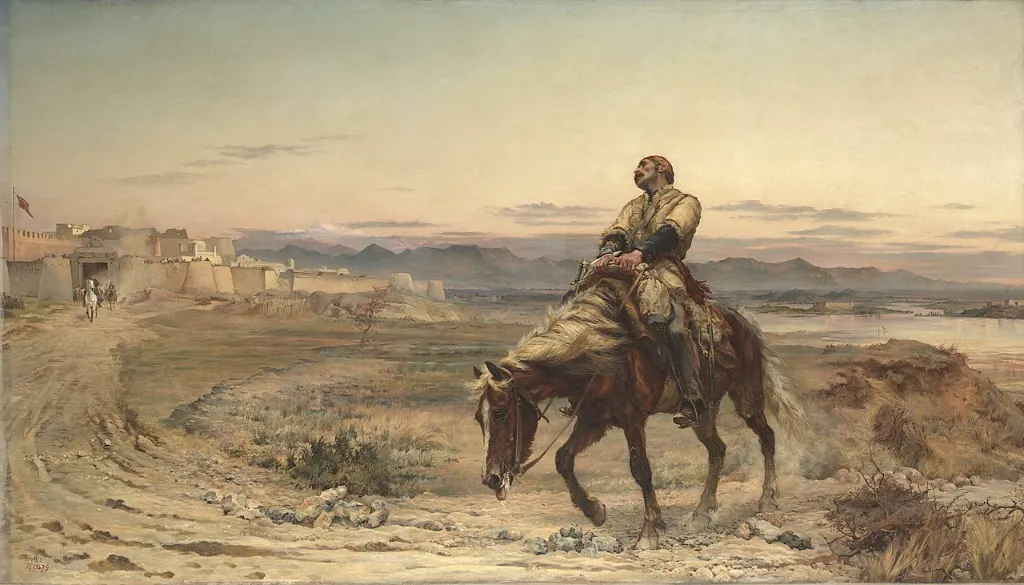
Elizabeth Butler’s Remnants of an Army (1879) is a monumental oil painting portraying the exhausted figure of William Brydon, a British assistant surgeon, staggering into Jalalabad on his weary horse. Depicted as the sole survivor of the British retreat from Kabul in January 1842 during the First Anglo-Afghan War, Brydon emerges alone from a desolate snowscape, his survival magnified into a symbol of tragedy and endurance. The painting’s stark realism and barren setting evoke both the personal ordeal of the subject and the wider devastation of imperial conflict.
Artistic and Social Context
Exhibited at the Royal Academy in 1879, Butler’s work drew immense public attention for its unflinching portrayal of failure rather than victory. At a time when military art often glorified triumphant campaigns, Remnants of an Army was striking for its commemoration of defeat, endurance, and loss. The First Anglo-Afghan War (1839–1842), fought as the British sought to secure influence in Afghanistan against Russian expansion, ended in disaster when a retreating force of some 16,000 soldiers and camp followers was almost annihilated during its passage through the mountain passes of Afghanistan. Brydon was famously thought to be the only survivor to reach safety, though in reality others were later released as prisoners. The painting resonated with Victorian audiences as an enduring image of imperial vulnerability, reminding Britain of the dangers of overreach.
Interpretation and Meaning
Butler’s canvas transcends its record of a historical episode to become an allegory for human weakness and the futility of war. The solitary rider represents not just survival but also the fragility of empire, stripped of its triumphal rhetoric. The cold, barren expanse dwarfs man and horse, underscoring themes of isolation, sacrifice, and the devastating consequences of imperial ambition. By capturing the silence of aftermath rather than scenes of battle, Butler invites reflection on dignity, resilience, and the human cost of conflict.
Size
The original size of Elizabeth Butler’s Remnants of an Army is approximately 132 × 233 cm (52 × 92 inches).