Two Swallows
by Wu Guanzhong
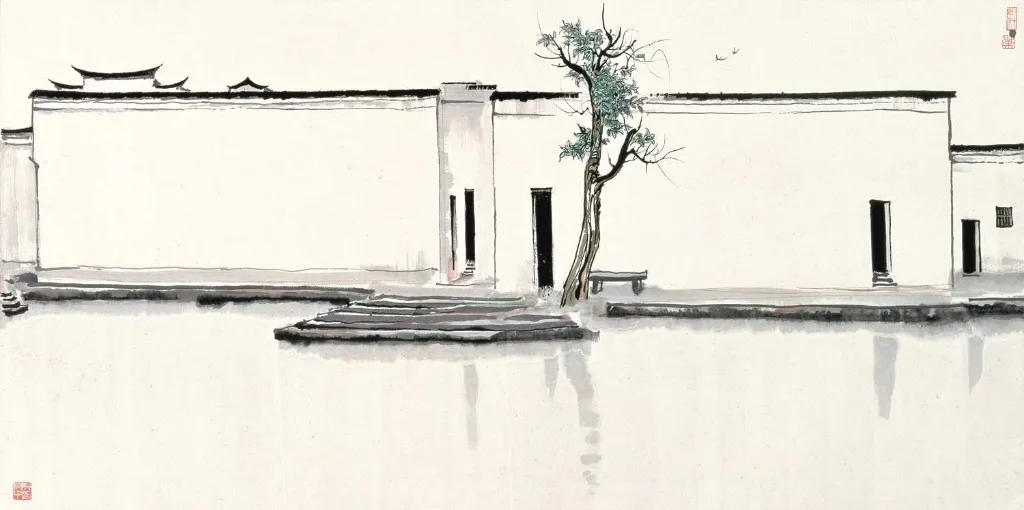
Description
Wu Guanzhong’s Two Swallows (1981) is a lyrical ink and color painting that captures the fleeting motion of two birds gliding above a simplified rural landscape. With bold brushstrokes and dynamic sweeps of line, Wu contrasts the delicate silhouettes of the swallows against a backdrop of white space and scattered architectural forms. The composition’s sparseness and rhythm convey both vitality and serenity, reflecting Wu’s fusion of Chinese ink traditions with modernist abstraction.
Artistic and Social Context
Created during a period when Wu sought to synthesize Chinese aesthetics with Western modernist ideas, Two Swallows exemplifies his pioneering role in redefining 20th-century Chinese painting. Trained in both China and France, Wu blended calligraphic line work with post-Impressionist spatial simplification, bridging two artistic worlds. Through this culturally hybrid style, he helped lay the foundation for modern Chinese art while preserving continuity with classical ink painting’s spirit of harmony between man and nature.
Interpretation and Meaning
Two Swallows transforms a fleeting natural encounter into a poetic meditation on freedom, vitality, and the balance between emptiness and form. The open expanse of white paper emphasizes the birds’ motion and weightlessness, while the scattered architectural strokes anchor their flight in human presence. For Wu, the swallows symbolize both joy and renewal, embodying a hopeful dialogue between tradition and innovation.
Size
The original size of Wu Guanzhong’s Two Swallows is approximately 68 × 68 cm (26 3/4 × 26 3/4 inches)