Introduction
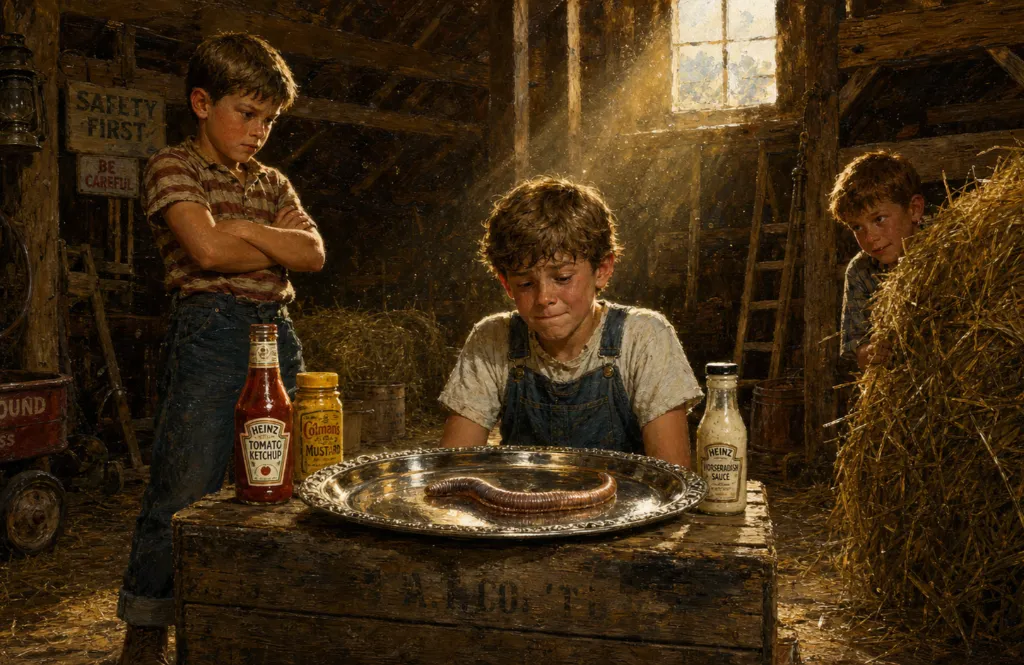
How to Eat Fried Worms (1973) by Thomas Rockwell—the son of iconic American painter Norman Rockwell—is a classic of children’s literature that follows the gutsy Billy Forrester. Driven by a desire to buy a secondhand minibike, Billy accepts a high-stakes bet to eat 15 worms in 15 days for $50. As Billy employs creative condiments like horseradish and mustard to manage the "gross-out" challenge, he must outwit his opponents, Alan and Joe, who resort to psychological warfare and physical sabotage to avoid paying up.
Cultural Importance
This novel is celebrated for pioneering the "gross-out" humor genre, effectively using visceral themes to engage reluctant readers—particularly boys—who connect with Billy’s mischievous bravado.Beyond its absurd premise, the book serves as a vital pedagogical tool for teaching social-emotional lessons on integrity, the weight of keeping one's word, and perseverance through unpleasant tasks.Its structural design, featuring 42 very short chapters and varied typography, was specifically crafted to build confidence and stamina in early chapter-book readers.
Recommended Reading Lists for UK and US Grades
UK: Often recommended for Key Stage 2 (ages 8–11), particularly within the Essex Lawford Mead Primary School and Scottish Book Trust lists as a vehicle for developing narrative fluency.
US: Frequently suggested for grades 3–6, with a Lexile measure of 560L and an Accelerated Reader (AR) level of 3.5. It is a staple for novel studies focused on character development and text-based evidence.
Film and Media Adaptations
Film: The 2006 film directed by Bob Dolman updates the narrative by moving the setting to a new school. In this version, Billy must eat 10 worms in a single Saturday to stand up to a school bully named Joe, shifting the theme toward social hierarchy and the courage to resist intimidation.
Television: An animated adaptation aired on CBS Storybreak in 1985, hosted by Bob Keeshan.This version remained faithful to the book’s 15-day timeline and was later used as a recommended educational tool by the Library of Congress.
Audiobook: The 2000 edition narrated by Jay O. Sanders is highly regarded for its high-energy performance, providing an immersive 1 hour and 53-minute experience that aids auditory learners in comprehending the story's tension.
Stage Play: Rockwell himself adapted the story into a script titled How to Eat Fried Worms and Other Plays (1980), which continues to be used for interactive theater programs in libraries and schools.
Knowledge Builder
Content
Chapter I: The Bet
1.1: Chapter I: The Bet
Chapter II: Digging
2.1: Chapter II: Digging
Chapter III: Training Camp
3.1: Chapter III: Training Camp
Chapter IV: The First Worm
4.1: Chapter IV: The First Worm
Chapter V: The Gathering Storm
5.1: Chapter V: The Gathering Storm
Chapter VI: The Second Worm
6.1: Chapter VI: The Second Worm
Chapter VII: Red Crash Helmets and White Jump Suits
7.1: Chapter VII: Red Crash Helmets and White Jump Suits
Chapter VIII: The Third Worm
8.1: Chapter VIII: The Third Worm
Chapter IX: The Plotters
9.1: Chapter IX: The Plotters
Chapter X: The Fourth Worm
10.1: Chapter X: The Fourth Worm
Chapter XI: Tom
11.1: Chapter XI: Tom
Chapter XII: The Fifth Worm
12.1: Chapter XII: The Fifth Worm
Chapter XIII: Nothing to Worry About
13.1: Chapter XIII: Nothing to Worry About
Chapter XIV: The Pain and the Blood and the Gore
14.1: Chapter XIV: The Pain and the Blood and the Gore
Chapter XV: 3:15 A.M.
15.1: Chapter XV: 3:15 A.M.
Chapter XVI: The Sixth Worm
16.1: Chapter XVI: The Sixth Worm
Chapter XVII: The Seventh Worm
17.1: Chapter XVII: The Seventh Worm
Chapter XVIII: The Eighth Worm
18.1: Chapter XVIII: The Eighth Worm
Chapter XIX: The Ninth Worm
19.1: Chapter XIX: The Ninth Worm
Chapter XX: Billy's Mother
20.1: Chapter XX: Billy's Mother
Chapter XXI: The Tenth Worm
21.1: Chapter XXI: The Tenth Worm
Chapter XXII: The Eleventh Worm
22.1: Chapter XXII: The Eleventh Worm
Chapter XXIII: Admirals Nagumo and Kusaka on the Bridge of the Akaiga, December 6, 1941
23.1: Chapter XXIII: Admirals Nagumo and Kusaka on the Bridge of the Akaiga, December 6, 1941
Chapter XXIV: The Twelfth Worm
24.1: Chapter XXIV: The Twelfth Worm
Chapter XXV: Pearl Harbor
25.1: Chapter XXV: Pearl Harbor
Chapter XXVI: Guadalcanal
26.1: Chapter XXVI: Guadalcanal
Chapter XXVII: The Thirteenth Worm
27.1: Chapter XXVII: The Thirteenth Worm
Chapter XXVIII: Hello, We're....
28.1: Chapter XXVIII: Hello, We're....
Chapter XXIX
29.1: Chapter XXIX
Chapter XXX: The Peace Treaty
30.1: Chapter XXX: The Peace Treaty
Chapter XXXI: The Letter
31.1: Chapter XXXI: The Letter
Chapter XXXII: Croak
32.1: Chapter XXXII: Croak
Chapter XXXIII: The Fourteenth Worm
33.1: Chapter XXXIII: The Fourteenth Worm
Chapter XXXIV: The Fifteenth....
34.1: Chapter XXXIV: The Fifteenth....
Chapter XXXV: Burp
35.1: Chapter XXXV: Burp
Chapter XXXVI: The Fifteenth Wo....
36.1: Chapter XXXVI: The Fifteenth Wo....
Chapter XXXVII: Out of the Frying Pan into the Oven
37.1: Chapter XXXVII: Out of the Frying Pan into the Oven
Chapter XXXVIII: $ % // ! ? Blip * / & !
38.1: Chapter XXXVIII: $ % // ! ? Blip * / & !
Chapter XXXIX: The United States Cavalry Rides over the Hilltop
39.1: Chapter XXXIX: The United States Cavalry Rides over the Hilltop
Chapter XL: The Fifteenth Worm
40.1: Chapter XL: The Fifteenth Worm
Chapter XLI: Epilogue
41.1: Chapter XLI: Epilogue
Instructor
Ming Aretê
Ming Aretê not only offers high‑quality Book Quizzes, but also curates beautifully designed cultural courses that guide students through both Chinese and international cultures, broadening horizons beyond reading alone.
Ming Aretê Presents Book Quizzes help students retain key knowledge about main characters, plot events, and important details from each chapter, while effectively testing and strengthening overall reading comprehension so that “reading a book” becomes truly “understanding a book.”