Introduction
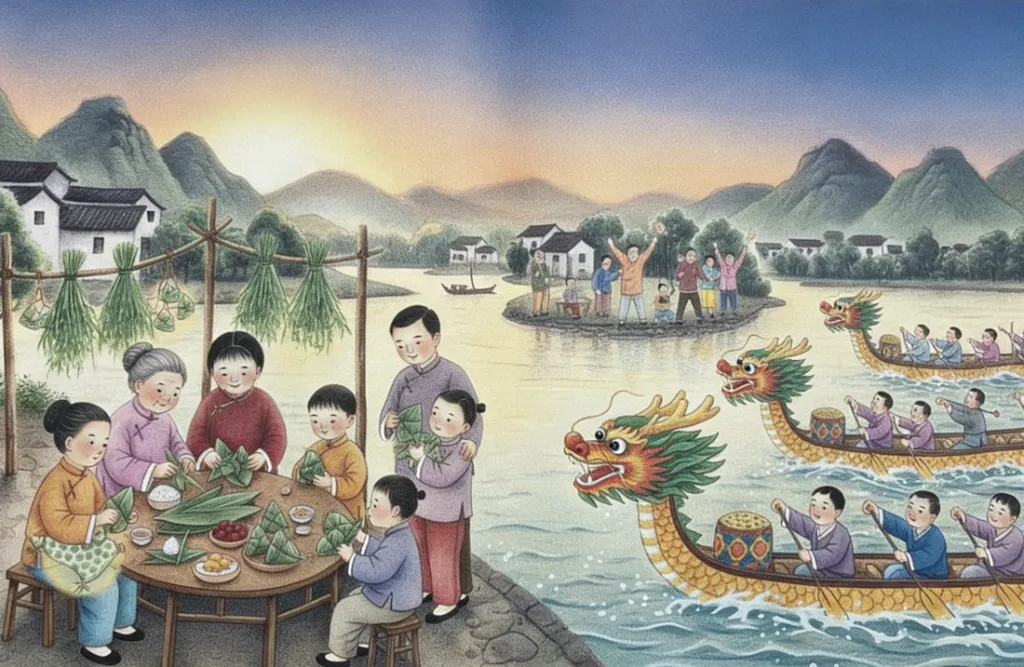
Zongzi are leaf‑wrapped sticky rice dumplings, usually filled with ingredients like beans, meat, egg yolk, or dates and tied into neat triangles or rectangles with string, but they are far more than just festival food. They are one of the most compact and recognizable “codes” of how Chinese culture remembers, feels, and tells its own stories across time, especially through the figure of the poet–statesman Qu Yuan. When you look at their layers of leaves, rice, fillings, and knots, they become tiny laboratories where history, loyalty, family affection, and everyday creativity interact—echoing the ancient tale of villagers casting rice into the river to honor Qu Yuan’s integrity and grief. When you pay attention to zongzi and the Dragon Boat Festival, you are really looking at how an ancient river, a poet’s final choice, and a family’s kitchen table can all belong to the same story about what a community chooses to remember and protect.
On the world stage, the Dragon Boat Festival has moved from a regional river ritual to a recognized part of shared global culture:
- In 2006 it was included in China’s first group of national intangible cultural heritage items, and in 2008 it became a public holiday again, signaling its importance in modern national life.
- In 2009, the Dragon Boat Festival was officially inscribed on UNESCO’s Representative List of the Intangible Cultural Heritage of Humanity. It was one of the first traditional Chinese festivals to receive this honor, marking Duanwu as part of humanity’s shared cultural legacy.
- In many North American and European cities, annual dragon boat festivals now attract thousands of participants and spectators, with mixed teams from schools, companies, charities, and community groups treating the races as both a sporting event and a celebration of Chinese heritage woven into local life.
- In major Chinatowns—from New York and San Francisco to London, Vancouver, and Sydney—Duanwu has become a regular feature of the neighborhood cultural calendar, with riverfront regattas, street fairs, and zongzi tastings drawing in visitors far beyond the Chinese community.
In this wider context, zongzi and the Dragon Boat Festival are no longer just “Chinese holidays” that you observe from the outside. Through this lesson, you can follow zongzi from its beginnings as an ancient ritual food to its later role as a symbol of remembrance, while also gaining a clearer picture of the historical world in which it emerged. As the elegant notes of the guzheng masterpiece “Fishermen’s Song at Dusk” (yú zhōu chàng wǎn) accompany your learning, you can immerse yourself not only in history but also in the soundscape of traditional Chinese aesthetics, feeling the quiet flow of rivers and the rhythm of time moving through melody and memory. Along the way, you learn how the Dragon Boat Festival took shape around the story of Qu Yuan, and meet the Spring and Autumn and Warring States periods of Chinese history as living contexts rather than distant names in a timeline. You can also, after completing the course, visit our poetry section to read and listen to Chinese poems related to Duanwu—such as “Granted Clothes on the Day of the Duanwu”, “Thinking of Li Bai at Sky’s End”, and “Song When Drunk”—so that historical narrative, lived custom, and classical verse come together, giving you a more human and fully rounded sense of what the Dragon Boat Festival means across time and cultures.
Knowledge Builder
Content
In this lesson, you will trace zongzi and the Dragon Boat Festival from simple leaf‑wrapped river offerings to a resonant emblem of remembrance built around the poet–official Qu Yuan. As you step into the Spring and Autumn and Warring States periods, court intrigues, collapsing kingdoms, and local rituals come into focus, revealing how one man’s loyalty and despair became folded—quite literally—into a festival food and a yearly act of collective memory.
1.1: Zongzi and the Dragon Boat Festival
1.2: Quiz
Instructor
Ming Aretê
Ming Aretê not only offers high‑quality Book Quizzes, but also curates beautifully designed cultural courses that guide students through both Chinese and international cultures, broadening horizons beyond reading alone.
Ming Aretê Presents Book Quizzes help students retain key knowledge about main characters, plot events, and important details from each chapter, while effectively testing and strengthening overall reading comprehension so that “reading a book” becomes truly “understanding a book.”