Introduction
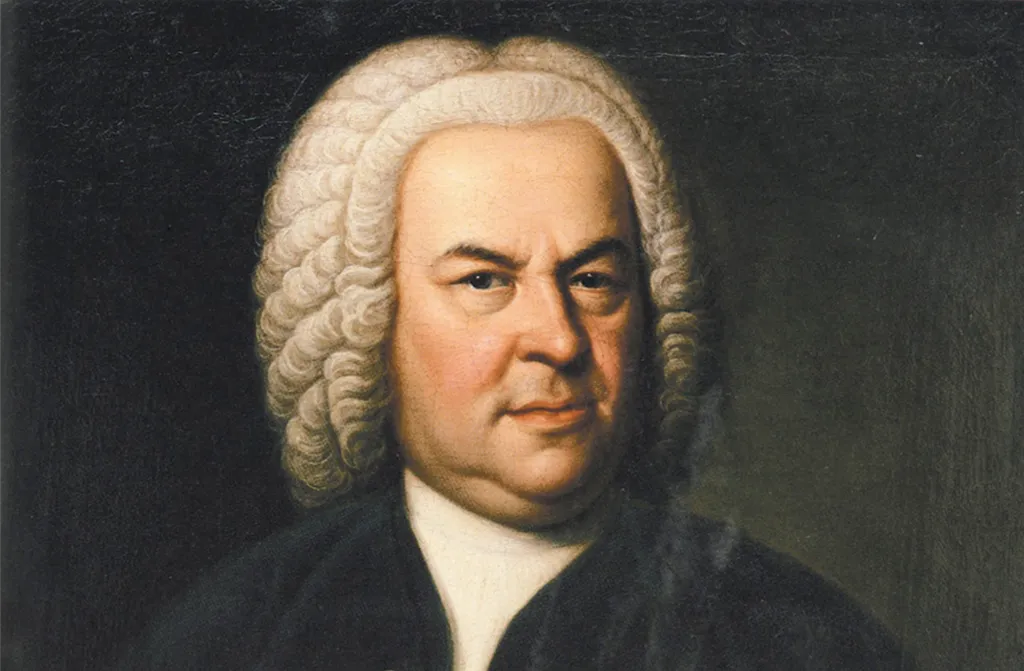
Johann Sebastian Bach (1685–1750) is not just another great composer; he is one of the main engineers of how Western music is built and understood. In his hands, fugues, chorales, and dance forms became laboratories where faith, intellect, and emotion interacted, turning strict musical designs into works of striking spiritual and human depth.
Bach’s presence is anything but distant or purely academic. His music seeps into everyday life: it is sung in churches, practiced in music schools, and heard in film soundtracks, television, games, ceremonies, and advertisements. Listeners who may never have studied a score still respond instinctively to his harmonies and melodies, which have come to signify order, gravity, tenderness, or awe in contemporary culture.
Notable examples include:
- The Toccata and Fugue in D minor, whose opening gestures have become an almost universal musical symbol for Gothic intensity, looming drama, and the supernatural.
- The Air on the G String from the Orchestral Suite No. 3, often chosen to accompany scenes of lingering nostalgia, romantic warmth, or gentle contemplation.
- The Brandenburg Concertos, regularly used whenever a bright, intricate, and energetic baroque atmosphere is needed in documentaries, historical dramas, or cultural broadcasts.
- Preludes and fugues from The Well-Tempered Clavier, which appear in teaching materials, jazz and pop adaptations, and intellectual-themed media as shorthand for clarity, structure, and mental focus.
For anyone who wishes to be genuinely at home in Western cultural traditions, Bach is indispensable. Standing between older church and court styles on one side and the Classical and Romantic masters on the other, he absorbed and systematized what came before, then handed later generations a rigorous musical toolkit that composers from Mozart to Brahms treated as foundational study. His legacy defines how harmony, counterpoint, and musical architecture are still taught and imagined today.
Knowledge Builder
Content
In this lesson, you will follow the journey of Johann Sebastian Bach from orphaned boy in Eisenach to tireless cantor in Leipzig and posthumous icon of Western music, discovering how family craft, faith, loss, and sheer discipline forged a composer who treated music as both language and architecture. Through landmark works such as the Well-Tempered Clavier, the Brandenburg Concertos, and the unfinished Art of Fugue, as well as the long-forgotten then rediscovered St. Matthew Passion, you will encounter an artist whose rigorous structures and deeply felt spirituality still shape how music is written, studied, and heard today.
1.1: Johann Sebastian Bach: Biography
1.2: Quiz
In this short course, you will move beyond Bach's biography and focus on listening closely to some of his most celebrated works. By revisiting these pieces with guided listening, you can enjoy their expressive power while strengthening your basic musical literacy. The next time you encounter these melodies, you may be surprised to find that you can recognize them by name!
2.1: Listening to Bach: An Appreciation Session
2.2: Recognizing Bach: Short Quiz
Instructor

Leonard Lindweld, MA
Leonard Lindweld is a Swedish pianist and educator. He holds a Bachelor’s degree in Performing Arts from Park University’s International Center for Music and Master’s degrees from the Grieg Academy in Bergen and the Norwegian Academy of Music, studying under Stanislav Ioudenitch, Einar Røttingen, Håvard Gimse and Leif Ove Andsnes.
He began piano at age six and joined Lilla Akademien at 12. He has won several international competitions, including the Shavshinsky Competition (St. Petersburg), the Stockholm International Piano Competition, and a Silver Medal at the Barletta Competition (Italy).
Lindweld has performed as a soloist and chamber musician in venues such as Berwald Hall, the Grieg Hall, the Royal Palace in Stockholm, and major concert halls across China. His performances have been broadcast on national media in Sweden, Norway, and Russia.
As Artist-in-Residence at KODE Bergen (2017-2018), he performed regularly at the homes of Edvard Grieg and Harald Sæverud. He has also lectured at institutions and festivals including Tencent, the Mozarteum Festival (Shenzhen), East & West Pianofest (Seoul), and the Vivace Piano Competition.
From 2018-2024, he served as Piano Faculty, Department Chair, and Artistic Director at Vanke Meisha Arts Academy (Shenzhen). He continues to teach at institutions such as Merchiston International School and Lidingö Musikskola.
Since 2025, Lindweld has been involved in Ming Areté, a startup aimed at reviving classical education in modern curricula. He is also a founding member of the Trout Quartet, which toured China in 2021.
His students have won awards and scholarships from Juilliard, Eastman, Vanderbilt, and the Purcell School. His teaching draws on the philosophies of Friedrich Wieck and Walter Gieseking, focusing on mental play and deep score analysis.
- 2020 Master's of Music Norwegian Academy
- 2018 Master’s of Music from University in Bergen’s Grieg Academy
- 2016 Bachelor's of performing arts at Park University’s International Center for Music in Kansas City