Introduction
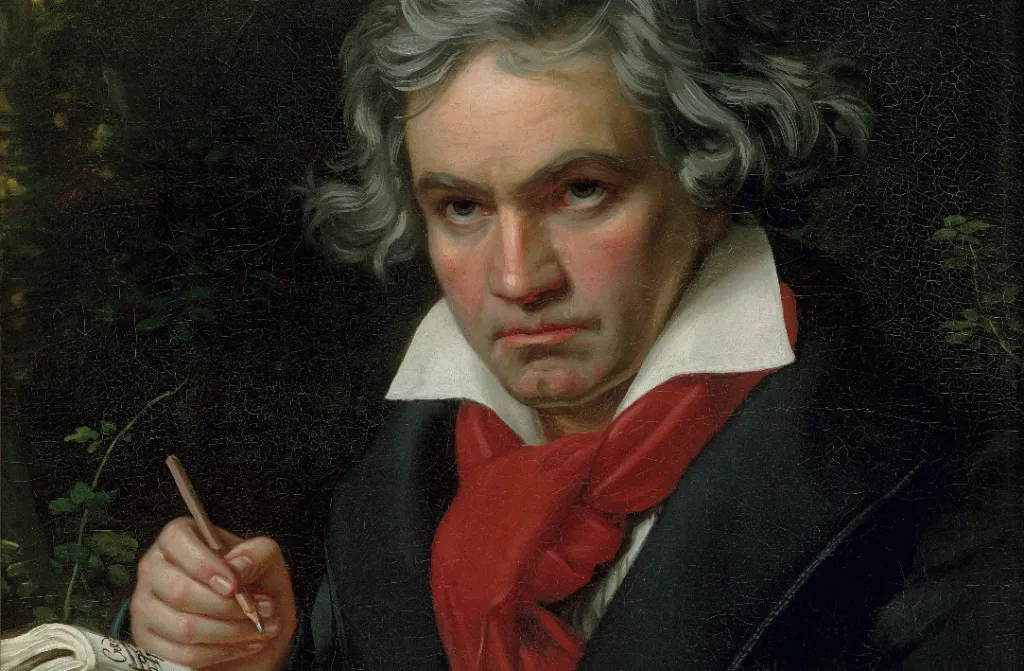
Ludwig van Beethoven (1770–1827) stands as one of the most important figures in all of music history because he single-handedly transformed how we think about art, emotion, and the human spirit. Straddling the Classical and Romantic eras, he took the elegant forms of Mozart and Haydn and charged them with raw drama, passion, and personal expression, turning music from courtly entertainment into a powerful mirror of the human soul. Despite going completely deaf by his mid-40s, he composed many of his greatest works—including the explosive Fifth Symphony, the heroic “Eroica” (Third), the revolutionary Ninth Symphony with its choral “Ode to Joy” (now the official anthem of Europe), the haunting “Moonlight” Sonata, the beloved “Für Elise,” and the intense “Pathétique” Sonata—entirely in his imagination, offering one of history’s most moving examples of triumph over suffering. By living as the first truly independent composer-celebrity, he made the artist a heroic figure who speaks directly to all humanity.
Today, his melodies are woven into the fabric of world culture: the unforgettable “da-da-da-daaa” of the Fifth rings out in movies and ringtones, the dreamy “Moonlight” Sonata drifts through films and recitals, the gentle “Für Elise” tinkles from ice-cream trucks and music boxes, and the soaring “Ode to Joy” lifts voices at weddings, Olympic ceremonies, political celebrations, and even in elevators. Knowing Beethoven matters because his music—forged in silence and struggle—has become a universal language instantly recognized across continents and generations, proving that one person’s courage and creativity can still unite, inspire, and soundtrack the entire world more than two centuries later.
Knowledge Builder
Content
In this lesson, you will explore the life and legacy of Ludwig van Beethoven, discovering how his early promise in Bonn, his triumphant yet turbulent years in Vienna, and his final heroic period of total deafness shaped his revolutionary music. Through stories of battling profound hearing loss and composing some of his greatest masterpieces—like the Third, Fifth, and Ninth Symphonies—entirely in his mind, students will understand what drove Beethoven to transform music into a voice for human struggle and hope, and why knowing his story remains essential for grasping resilience, creativity, and the power of the human spirit. They will also encounter some of his most iconic works—including the “Pathétique” Sonata, Symphony No. 5, the “Eroica” Symphony, the Ninth Symphony, and the “Ode to Joy”—learn to identify key melodies that are universally recognized around the world today, and see why, two centuries later, Beethoven continues to inspire courage, freedom, and connection across cultures.
1.1: Ludwig van Beethoven: Biography
1.2: Quiz
Instructor

Leonard Lindweld, MA
Leonard Lindweld is a Swedish pianist and educator. He holds a Bachelor’s degree in Performing Arts from Park University’s International Center for Music and Master’s degrees from the Grieg Academy in Bergen and the Norwegian Academy of Music, studying under Stanislav Ioudenitch, Einar Røttingen, Håvard Gimse and Leif Ove Andsnes.
He began piano at age six and joined Lilla Akademien at 12. He has won several international competitions, including the Shavshinsky Competition (St. Petersburg), the Stockholm International Piano Competition, and a Silver Medal at the Barletta Competition (Italy).
Lindweld has performed as a soloist and chamber musician in venues such as Berwald Hall, the Grieg Hall, the Royal Palace in Stockholm, and major concert halls across China. His performances have been broadcast on national media in Sweden, Norway, and Russia.
As Artist-in-Residence at KODE Bergen (2017-2018), he performed regularly at the homes of Edvard Grieg and Harald Sæverud. He has also lectured at institutions and festivals including Tencent, the Mozarteum Festival (Shenzhen), East & West Pianofest (Seoul), and the Vivace Piano Competition.
From 2018-2024, he served as Piano Faculty, Department Chair, and Artistic Director at Vanke Meisha Arts Academy (Shenzhen). He continues to teach at institutions such as Merchiston International School and Lidingö Musikskola.
Since 2025, Lindweld has been involved in Ming Areté, a startup aimed at reviving classical education in modern curricula. He is also a founding member of the Trout Quartet, which toured China in 2021.
His students have won awards and scholarships from Juilliard, Eastman, Vanderbilt, and the Purcell School. His teaching draws on the philosophies of Friedrich Wieck and Walter Gieseking, focusing on mental play and deep score analysis.
- 2020 Master's of Music Norwegian Academy
- 2018 Master’s of Music from University in Bergen’s Grieg Academy
- 2016 Bachelor's of performing arts at Park University’s International Center for Music in Kansas City