Introduction
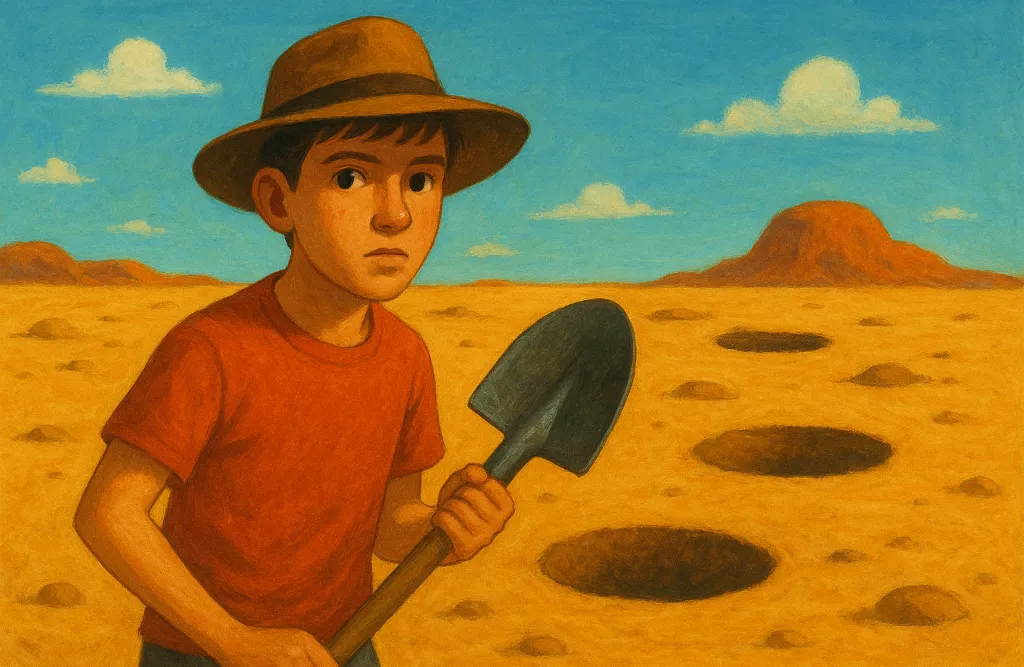
Louis Sachar’s Holes (1998), recipient of both the Newbery Medal and the National Book Award, is a darkly humorous yet profoundly human story that layers history, myth, and moral reflection into one inventive modern classic. Set in the desolate landscape of Camp Green Lake—a juvenile detention center in Texas where boys dig endless holes “to build character”—the novel follows Stanley Yelnats IV, a boy wrongfully convicted of theft and caught in the shadow of a generations-old family curse. Through the intertwining narratives of Stanley, his ancestor Elya Yelnats, and the tragic outlaw Kate Barlow, Sachar weaves a tale about crime, redemption, fate, and friendship. As Stanley digs deeper into the dry earth, he unearths truths buried far beyond the physical world: the meaning of justice, the resilience of the human spirit, and the transformative power of loyalty and compassion.
Cultural Importance
Holes stands as one of the most distinctive works in late 20th‑century American children’s literature, combining fable‑like storytelling with biting social commentary. It reflects themes of racial injustice, intergenerational trauma, and the absurdity of punitive institutions—all rendered accessible through Sachar’s playful prose and tightly structured plotting. The novel’s cyclical motif of history and consequence introduces young readers to moral complexity without moralizing, making it both instructive and deeply entertaining. Since its publication, Holes has become a staple of middle‑school curricula across the United States, praised for its balance of humor and depth and its ability to spark discussion about fairness and forgiveness.
Recommended Reading Lists for UK and US Grades
UK: Frequently recommended for Key Stage 3 (ages 11–14), Holes is used to explore narrative structure, motif, and tone. Teachers use the text to analyze how multiple timelines converge to reveal moral resolution and to discuss the concept of justice within literary storytelling.
US: Commonly taught in grades 6–8, the novel appears on Common Core reading lists and award‑winning literature programs for its layered narrative and character development. It is also used in social studies‐integrated units to prompt conversations about ethics, history, and rehabilitation in youth systems.
Film and Media Adaptations
- Film (2003): Walt Disney Pictures’ adaptation, directed by Andrew Davis and starring Shia LaBeouf as Stanley, captures the novel’s humor and moral intricacy, earning critical acclaim for its fidelity to Sachar’s vision (the author himself wrote the screenplay).
- Audiobooks: Narrated by Kerry Beyer and later by Kerry Beyer’s successors, the audiobook editions highlight Sachar’s rhythmic prose and characteristic wit.
- Stage and Classroom Adaptations: Various dramatizations have been used in schools worldwide, emphasizing teamwork, perseverance, and moral decision‑making through interactive performance.
Through its intricate structure, satirical voice, and emotionally resonant characters, Holes continues to captivate readers across generations—reminding them that what we dig up from the past often shapes who we become, and that redemption lies not in luck, but in courage and compassion.
Knowledge Builder
Content
Chapter 1
1.1: Chapter 1
Chapter 2
2.1: Chapter 2
Chapter 3
3.1: Chapter 3
Chapter 4
4.1: Chapter 4
Chapter 5
5.1: Chapter 5
Chapter 6
6.1: Chapter 6
Chapter 7
7.1: Chapter 7
Chapter 8
8.1: Chapter 8
Chapter 9
9.1: Chapter 9
Chapter 10
10.1: Chapter 10
Chapter 11
11.1: Chapter 11
Chapter 12
12.1: Chapter 12
Chapter 13
13.1: Chapter 13
Chapter 14
14.1: Chapter 14
Chapter 15
15.1: Chapter 15
Chapter 16
16.1: Chapter 16
Chapter 17
17.1: Chapter 17
Chapter 18
18.1: Chapter 18
Chapter 19
19.1: Chapter 19
Chapter 20
20.1: Chapter 20
Chapter 21
21.1: Chapter 21
Chapter 22
22.1: Chapter 22
Chapter 23
23.1: Chapter 23
Chapter 24
24.1: Chapter 24
Chapter 25
25.1: Chapter 25
Chapter 26
26.1: Chapter 26
Chapter 27
27.1: Chapter 27
Chapter 28
28.1: Chapter 28
Chapter 29
29.1: Chapter 29
Chapter 30
30.1: Chapter 30
Chapter 31
31.1: Chapter 31
Chapter 32
32.1: Chapter 32
Chapter 33
33.1: Chapter 33
Chapter 34
34.1: Chapter 34
Chapter 35
35.1: Chapter 35
Chapter 36
36.1: Chapter 36
Chapter 37
37.1: Chapter 37
Chapter 38
38.1: Chapter 38
Chapter 39
39.1: Chapter 39
Chapter 40
40.1: Chapter 40
Chapter 41
41.1: Chapter 41
Chapter 42
42.1: Chapter 42
Chapter 43
43.1: Chapter 43
Chapter 44
44.1: Chapter 44
Chapter 45
45.1: Chapter 45
Chapter 46
46.1: Chapter 46
Chapter 47
47.1: Chapter 47
Chapter 48
48.1: Chapter 48
Chapter 49
49.1: Chapter 49
Chapter 50
50.1: Chapter 50
Instructor

Ming Aretê
Ming Aretê Presents Book Quizzes will help you retain knowledge about main characters, events, and details from each chapter while test reading comprehension effectively.