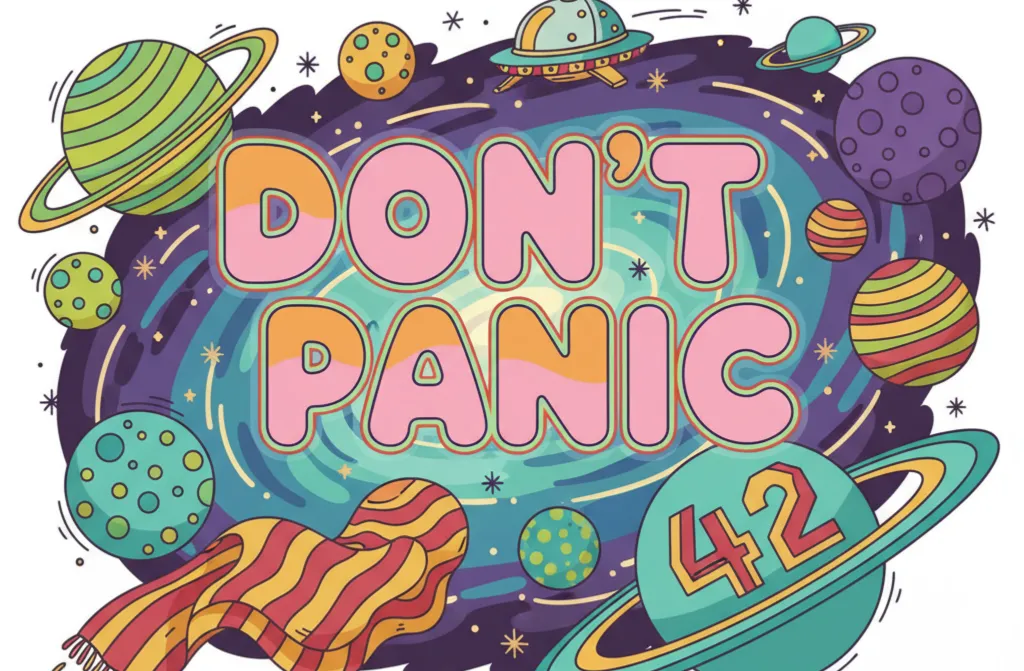
Introduction
Douglas Adams’s The Hitchhiker’s Guide to the Galaxy, first published in 1979, is a groundbreaking science fiction novel that blends cosmic adventure with sharp British wit. The story follows Arthur Dent, an ordinary Englishman whose home—and entire planet—are destroyed to make way for an intergalactic highway. Rescued by his eccentric friend Ford Prefect (an alien researcher for the titular guidebook), Arthur is thrust into a series of absurd and philosophical adventures across the universe. Alongside Ford, the two-headed President of the Galaxy Zaphod Beeblebrox, the brilliant Trillian, and Marvin the perpetually depressed robot, Arthur encounters the strange and the sublime while trying to make sense of life, the universe, and everything. Known for its satirical tone and surreal humor, the novel playfully challenges human assumptions about meaning, intelligence, and existence, marking a new kind of comedic science fiction that continues to captivate readers of all ages.
Cultural Importance
The Hitchhiker’s Guide to the Galaxy by Douglas Adams is important not just as a science fiction story, but as a piece of modern culture. It changed the way people think about space, life, and even humor. Instead of telling a serious hero’s story, Adams used comedy and absurdity to explore big questions about the universe and the meaning of life — famously summed up by the answer “42.” The book’s mix of wit, imagination, and philosophy made it a symbol of British humor and inspired later writers and movies. Its ideas, like the electronic “Guide” that knows everything, even predicted the way people use the internet and Wikipedia today. In short, the novel reminds readers that laughter can be a powerful way to think about serious ideas.
Elon Musk is a huge fan of The Hitchhiker's Guide to the Galaxy—it's one of his all-time favorite books and has deeply influenced his worldview, business philosophy, and even the design of xAI's Grok AI. He has frequently cited it as a key inspiration, calling Adams his "favorite philosopher" for the book's blend of humor, absurdity, and profound questions about the universe, life, and existence. For instance, Musk has explained that the novel taught him the importance of questioning not just answers, but the right questions to ask in the first place.
Recommended Reading Lists for UK and US Grades
The Hitchhiker’s Guide to the Galaxy frequently appears on recommended reading lists for upper secondary students in both the UK and US, typically for ages 13–17 (UK Years 8–11; US Grades 8–12).
UK: The novel appears on several national and school-level reading lists. It is featured on the School Reading List for KS3 students (Years 8–9, ages 12–14) and listed among the Best Books for Year 9 and in Broughton Hall Catholic High School’s KS3 Recommended Reading List, reflecting its role as a bridge between young-adult fiction and mature literary satire. English departments often recommend it for classroom discussions in KS3 and KS4 as an introduction to modern British science fiction and comedic social commentary.
US: In the United States, the book is commonly included in upper middle and high school curricula—particularly Grades 9–12—as part of units on satire, irony, or speculative fiction. It appears in Common Core-aligned supplemental reading programs and on recommended lists from TeachingBooks, Scholastic, and state reading programs such as those in California and Texas. Educators value it for developing students’ critical reading skills, especially in identifying tone, humor, and subtext in complex literature.
Film and Media Adaptations
The novel’s success led to many fun adaptations:
- BBC Radio Series (1978): The story first appeared as a radio show that became an instant hit.
- BBC TV Series (1981): A clever, low-budget version that turned the book’s humor into visual comedy.
- Feature Film (2005): A movie introducing the story to a new audience, starring Martin Freeman as Arthur Dent.
- Audiobooks and Stage Versions: These let new generations enjoy the story’s comic chaos in fresh ways.
The Hitchhiker’s Guide to the Galaxy thrives not just as a story about space travel but as a witty meditation on human existence—reminding readers that curiosity and laughter remain our best tools for navigating the mysteries of life, the universe, and everything.
Knowledge Builder
Content
Chapter 1
1.1: Chapter 1
Chapter 2
2.1: Chapter 2
Chapter 3
3.1: Chapter 3
Chapter 4
4.1: Chapter 4
Chapter 5
5.1: Chapter 5
Chapter 6
6.1: Chapter 6
Chapter 7
7.1: Chapter 7
Chapter 8
8.1: Chapter 8
Chapter 9
9.1: Chapter 9
Chapter 10
10.1: Chapter 10
Chapter 11
11.1: Chapter 11
Chapter 12
12.1: Chapter 12
Chapter 13
13.1: Chapter 13
Chapter 14
14.1: Chapter 14
Chapter 15
15.1: Chapter 15
Chapter 16
16.1: Chapter 16
Chapter 17
17.1: Chapter 17
Chapter 18
18.1: Chapter 18
Chapter 19
19.1: Chapter 19
Chapter 20
20.1: Chapter 20
Chapter 21
21.1: Chapter 21
Chapter 22
22.1: Chapter 22
Chapter 23
23.1: Chapter 23
Chapter 24
24.1: Chapter 24
Chapter 25
25.1: Chapter 25
Chapter 26
26.1: Chapter 26
Chapter 27
27.1: Chapter 27
Chapter 28
28.1: Chapter 28
Chapter 29
29.1: Chapter 29
Chapter 30
30.1: Chapter 30
Chapter 31
31.1: Chapter 31
Chapter 32
32.1: Chapter 32
Chapter 33
33.1: Chapter 33
Chapter 34
34.1: Chapter 34
Chapter 35
35.1: Chapter 35
Instructor
Ming Aretê
Ming Aretê Presents Book Quizzes will help you retain knowledge about main characters, events, and details from each chapter while test reading comprehension effectively.